
Most visitors to Notre Dame Cathedral spend their time looking upward at the towers. They admire the gargoyles and the flying buttresses. Very few people stop to consider what lies directly beneath their feet. The ground under the Parvis Notre Dame holds more than 2,000 years of continuous human history. The Archaeological Crypt of Notre Dame gives visitors direct access to that history. It uses preserved ruins and multimedia exhibits. These displays provide physical evidence of how Paris grew from a Roman settlement into a great city. It is one of the most significant and least crowded attractions in Paris. It deserves far more attention than it typically receives.
How the Crypt Came to Exist
The Archaeological Crypt of Notre Dame exists because authorities abandoned an original plan. In the 1960s, city officials began excavating beneath the square to build a parking garage. Work proceeded between 1965 and 1972. Archaeologists accompanied the construction crews during this time. It soon became clear that the ground was very valuable. Layer after layer of history came to light. Some ruins stretched back to the period when Paris was a Roman city called Lutetia. The finds proved extensive. Because of this, the city dropped the parking garage plan. Officials chose to preserve the ruins and open them to the public instead. The museum opened in 1980. It covers approximately 2,000 square meters. It is currently the largest archaeological crypt in Europe.
What the Ruins Actually Show
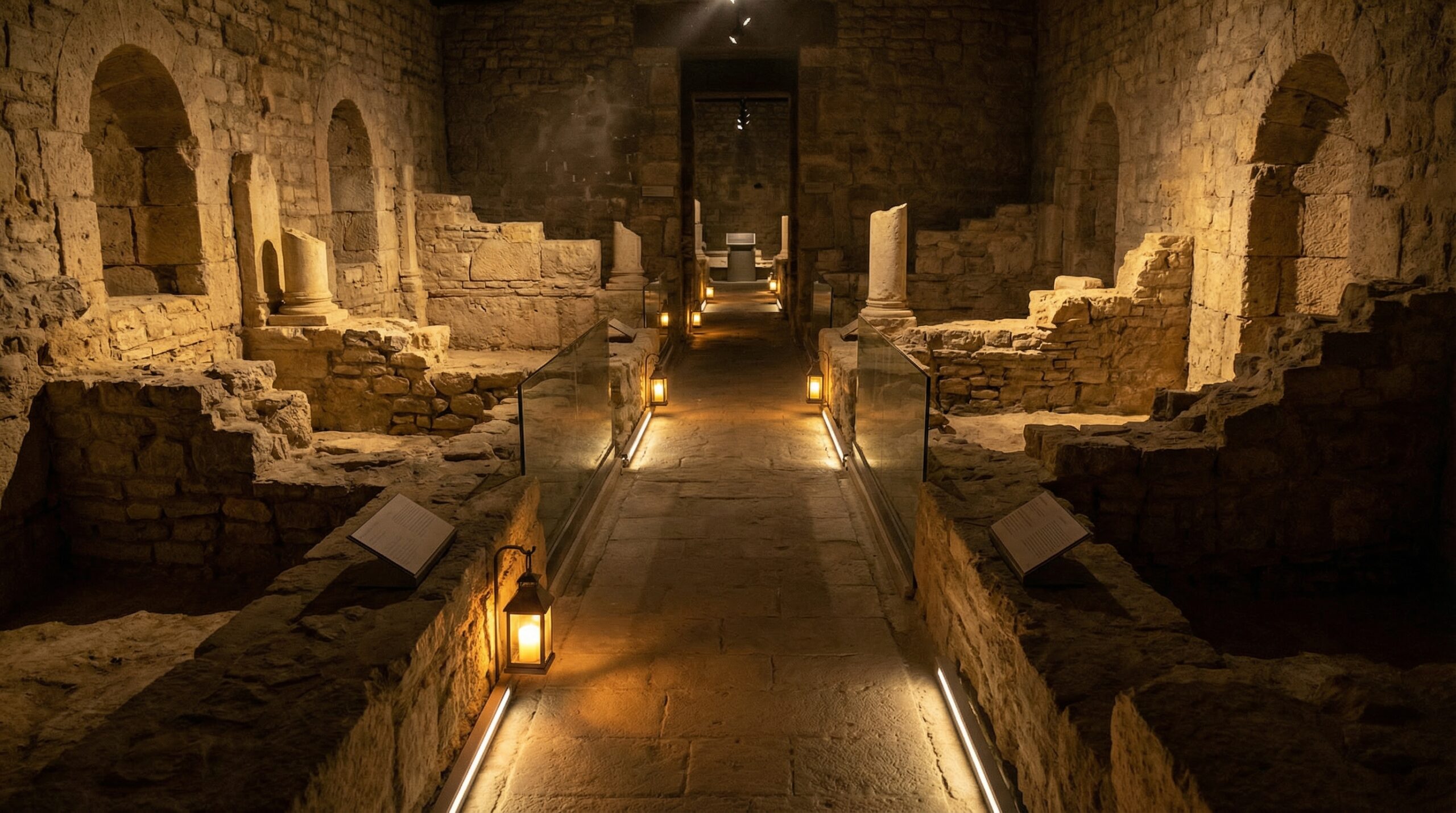
Visitors move through multiple distinct periods of Parisian history inside the Archaeological Crypt of Notre Dame. The oldest remains date to the Gallo-Roman period. At that time, the island was the center of Lutetia. A preserved river wharf is one of the most striking features. Stone steps once led directly from this wharf to the Seine. The river has shifted its course over the centuries. Today, the water runs about 50 meters away from the old steps. Foundations of Roman public baths are also visible. You can also see sections of city walls built in the 4th century.
The crypt also displays the remains of medieval Paris. The foundations of a 12th-century house remain in good condition. You can see the ruins of the Rue Neuve Notre Dame as well. This medieval street once ran through the open square. The exhibition includes the basement of the original hospital of Paris. Traces of a 19th-century sewer system represent the most recent layer. This infrastructure appeared during the urban renovation program of Baron Haussmann. The crypt serves as a physical record of the entire history of the city.
The Museum Experience Inside the Crypt
The Archaeological Crypt of Notre Dame functions as a modern museum. Experts designed the experience to make the ruins understandable for everyone. You do not need a background in archaeology to enjoy it. Scale models show how the island changed over time. Multimedia displays and detailed maps accompany the physical remains. The space also includes an exhibition about the construction of the cathedral. This helps connect the underground ruins to the famous structure above.
An audio guide is available at the entrance in multiple languages. It takes approximately 30 minutes to complete. This guide provides narration for every significant section. It is a practical choice for visitors who want a deep understanding of the site. You can also book group tours in advance. Lighting inside the crypt highlights the structures clearly. The atmosphere feels immersive and well-paced.
Practical Information for Your Visit
The Archaeological Crypt of Notre Dame is located at 7 Place Jean-Paul II. You will find it directly beneath the forecourt of the cathedral. The entrance sits on the north side of the square. It is open Tuesday through Sunday from 10:00 AM to 6:00 PM. Ticket sales close at 5:30 PM. The crypt is closed on Mondays and certain holidays. The site is part of the Paris Museum Pass, which covers many monuments across the city.
The closest metro stations are Cite and Saint-Michel on Line 4. The RER B and C lines also stop nearby at Saint-Michel Notre Dame. You may take photos inside the crypt. However, flash photography and tripods are not allowed. You cannot bring food or drinks inside. The crypt is fully wheelchair accessible through the use of ramps. Plan for at least 45 minutes for a basic visit. You may need 90 minutes if you use the audio guide and view all the exhibits.
Why This Site Matters
Paris has been rebuilt many times. Very little evidence of its earliest periods survives above ground today. The Archaeological Crypt of Notre Dame is a rare place. It preserves the full sequence of the city’s transformation in one location. The Roman quay and medieval foundations tell a powerful story. They show a city that has never stopped changing. Travelers who want to understand Paris should visit this site. It provides context that the cathedral alone cannot offer. It is worth building your entire visit to the area around this museum.
Plan your Paris trip with Uncle Sam Tours. Make sure the Archaeological Crypt of Notre Dame is on your itinerary. Contact our team to start building a custom visit. We cover the full history of the island. Explore more Paris attractions with Uncle Sam Tours and travel with total confidence.