
Paris holds more art museums per square kilometer than almost any city on earth and yet the Musée de l’Orangerie Paris stands out for reasons that have nothing to do with size. Tucked into the southwest corner of the Tuileries Garden, right beside the Place de la Concorde, this museum occupies a long stone building that once kept orange trees alive through Parisian winters. Today it keeps something far more lasting alive. It houses eight of the most extraordinary paintings ever made along with a second floor of French modern art that would be the centerpiece of any other institution in the world.
History of the Musée de l’Orangerie Paris
Napoleon III commissioned the original structure in 1852 and gave architect Auguste Bourgeois just four months to complete it. The brief was practical. He needed to build a winter shelter for the citrus trees of the Tuileries. Bourgeois designed accordingly and fitted the south facade with glass panels to catch sunlight from the Seine. He left the north wall almost entirely solid to block the cold winds coming off the Rue de Rivoli. The result looked less like a palace outbuilding and more like an elongated greenhouse made respectable. This is precisely what it was for many years.
The building’s conversion to an art gallery began in earnest after World War One. At that time, Claude Monet agreed to donate his monumental Water Lilies cycle to the French state as a gift marking the armistice. Monet worked alongside architect Camille Lefèvre to redesign the eastern half of the building into two oval rooms arranged to form the shape of an infinity symbol. The museum named for him, the Musée Claude Monet, opened on May 17, 1927. This happened several months after the painter’s death. The building was then joined administratively to the Louvre in 1930 and decades of exhibitions followed.
Between 2000 and 2006, a major renovation costing around 30 million euros took place. This project stripped back the false ceilings that had blocked natural light from the Water Lilies since 1965. It also created more than 1,000 square meters of new underground gallery space beneath the Tuileries terrace. The museum we visit today is the direct result of that six-year project.
Monet’s Water Lilies at Musée de l’Orangerie Paris
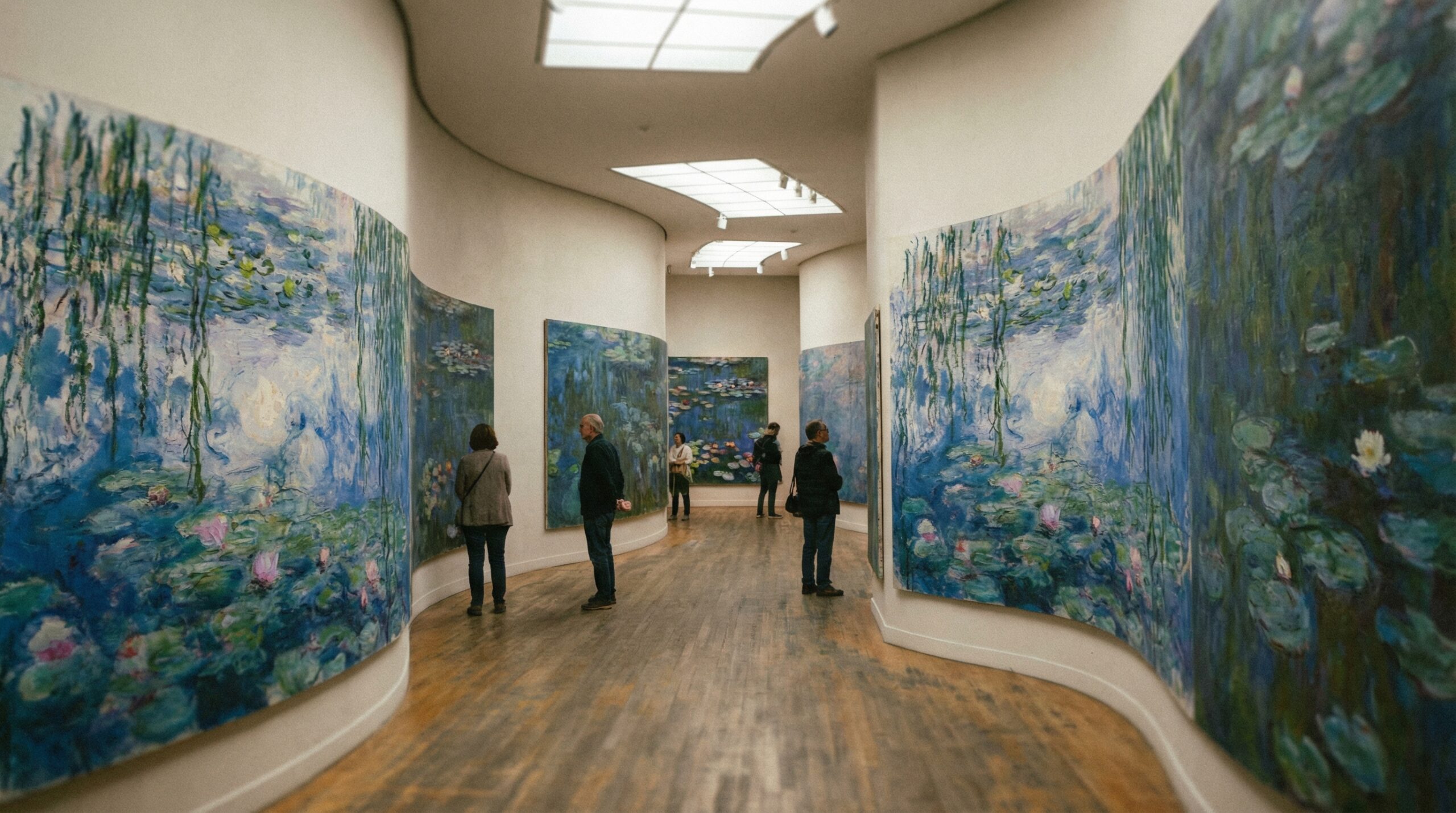
The ground floor of the Musée de l’Orangerie Paris is defined by two oval rooms that together hold eight massive panels from Monet’s Les Nymphéas cycle. Each panel stands two meters high and the total width of all eight stretched end to end reaches 91 meters. Monet designed these rooms himself and insisted on skylights rather than artificial light. He wanted the paintings to shift with the weather, the time of day and the season.
That relationship between the paintings and the light above them was not accidental. Monet spent the last three decades of his life working on this cycle in his garden at Giverny in Normandy. He wanted viewers to feel surrounded by water and sky rather than standing in front of a framed canvas. He referred to the installation as a sanctuary for peaceful meditation.
The oval shape of the rooms prevents any single vantage point from dominating the viewer. Visitors naturally circle the space and the paintings respond differently depending on where they stand. Some panels lean toward the blue and green of midday water while others carry the warm golds and pinks of dusk. There are benches in the center of each oval room. Taking time to sit with the paintings rather than photograph them quickly rewards patience in a way that few museum experiences do.
The Walter-Guillaume Collection at Musée de l’Orangerie Paris
Below the Water Lilies rooms, the lower level houses the Jean Walter and Paul Guillaume collection. This is one of the most concentrated gatherings of French modern and impressionist painting anywhere in the world. Paul Guillaume was a Paris art dealer who opened his first gallery in 1914. He spent the next two decades building relationships with artists who were still largely unknown to the public.
By the time of his death in 1934, he had assembled works by Pierre-Auguste Renoir, Paul Cézanne, Henri Matisse, Pablo Picasso and Amedeo Modigliani. The collection eventually passed to the French state and was formally inaugurated at the Orangerie in 1966 by Minister of Culture André Malraux. It became permanently housed in the museum after the death of Guillaume’s widow, Domenica Walter, in 1977.
The lower level currently holds 146 paintings from this collection. There are 25 Renoirs and 15 Cézannes. You can also find works by Matisse, Picasso and Modigliani. There are also paintings by Derain, Soutine, Marie Laurencin, Maurice Utrillo and Paul Gauguin. The rooms are intimate and relatively uncrowded compared to the Water Lilies galleries above. This makes the floor a genuinely good place to spend time looking carefully at individual works rather than moving through the space quickly.
Architecture of the Musée de l’Orangerie Paris
The renovation that concluded in 2006 was vital for the survival of the museum. Before this project, the Water Lilies were often viewed under harsh and unchanging artificial lights. The return to natural lighting restored Monet’s original vision for the Musée de l’Orangerie Paris. The architects discovered that by digging beneath the terrace, they could expand the museum without altering the historical exterior of the building.
This underground expansion includes a shop, a cafe and spaces for temporary exhibitions. The transition between the bright and airy upper level and the modern and sleek lower level is handled through a grand staircase. This creates a sense of discovery as visitors move from the Impressionist masterpieces above to the Modernist works below.
Visiting the Musée de l’Orangerie Paris
The Musée de l’Orangerie Paris is open Wednesday through Monday from 9:00 am to 6:00 pm. The last admission is at 5:15 pm and the galleries close at 5:45 pm. The museum is closed on Tuesdays and it is also closed on May 1, the morning of July 14 and December 25.
The standard adult admission fee is 12.50 euros and reduced rates are available for certain categories of visitors. Visitors under 18 years old enter free of charge. This free entry also applies to visitors on the first Sunday of each month. Special exhibitions are usually included in the general admission price.
Booking tickets in advance is strongly recommended for everyone. The museum is popular and walk-up tickets often run out during peak travel months. The Orangerie is located at the western end of the Tuileries Garden near Place de la Concorde. The closest metro station is Concorde which is served by lines 1, 8 and 12. From the Louvre, the walk through the Tuileries takes roughly 15 minutes. Several bus lines including the 24, 42, 72 and 73 also stop near the museum entrance.
Advice for a Better Experience
To avoid the largest crowds, try to visit on a weekday morning as soon as the museum opens. If you prefer a quieter atmosphere, the late afternoon after 4:00 pm is also a good time to explore the lower level. Since the museum is smaller than the Louvre or the Musée d’Orsay, a thorough visit usually takes between 90 minutes and two hours.
Security checks are mandatory at the entrance. Large bags and suitcases are not permitted inside the museum and there are no lockers available for oversized items. Photography is allowed in most areas but you must turn off your flash to protect the delicate pigments in the paintings. Using a tripod or selfie stick is prohibited.
Why the Musée de l’Orangerie Paris Matters Today
In a world of massive and overwhelming museums, the Musée de l’Orangerie Paris offers a moment of focus. It does not try to tell the entire history of art. Instead, it invites you to look deeply at a specific moment in time when art moved from representing the world to expressing an internal experience. Monet’s Water Lilies serve as a bridge between the 19th and 20th centuries. They represent the culmination of Impressionism and the beginning of abstraction.
The museum remains a testament to the generosity of artists and collectors who wanted their treasures to be accessible to the public. It is a place where architecture, light and painting come together to create a unique sensory experience. Whether you are an art historian or a casual traveler, the Orangerie provides a sense of peace that is hard to find elsewhere in the busy center of Paris.
Plan your trip with us
If you are planning a trip to Paris and want to make the most of every hour at the Musée de l’Orangerie Paris and the other great museums this city holds, a guided tour makes a real difference. Uncle Sam Tours offers expert-led Paris experiences that take you past the queues and into the details that matter. Visit Uncle Sam Tours to book your guided Paris tour today.