
Paris holds more history per square meter than almost any other city on earth. One of its most extraordinary monuments manages to stay quietly hidden from plain sight. Sainte Chapelle Paris sits tucked inside the Palais de Justice complex on the Ile de la Cité. This island sits at the very heart of the city where Paris itself was born.
You would barely notice it from the street. It has no grand forecourt or open plaza. You will not find a sweeping approach. Only a slender Gothic spire rises above the rooftops of the law courts. When you walk inside, nothing feels ordinary anymore. This guide covers everything you should know before you go. We include the history of the chapel and what you will find on both floors. We also provide practical advice to help you maximize your time there.
The History Behind the Chapel
King Louis IX of France commissioned Sainte Chapelle in the early 13th century. The church later canonized him as Saint Louis. He built the chapel with a single purpose in mind. He had acquired a collection of relics from the Passion of Christ. His most notable acquisition was the Crown of Thorns. He purchased this in 1239 from Baldwin II, the Emperor of Constantinople. Reports suggest the price for those relics was higher than the entire cost of the chapel construction. This shows how seriously Louis regarded this project.
Construction began in 1242 and finished in 1248. This remarkable six-year timeline is impressive given the architectural ambition of the structure. Most historians credit Pierre de Montreuil with the design, though records from the period remain incomplete. Louis wanted a monumental reliquary. He envisioned a building that would function as an enormous jeweled container for his sacred collection.
The Political Significance of the Chapel
The chapel was also a political statement. Louis IX positioned Paris as the keeper of Christ’s relics. He effectively placed France at the center of the Christian world. This move made Paris second in importance only to Jerusalem. The chapel formed part of the Palais de la Cité. This was the royal residence where French kings lived until the 14th century.
Along with the adjacent Conciergerie, it is one of the only surviving structures from that original palace complex. During the French Revolution, officials stripped Sainte Chapelle of its furnishings. They repurposed the building as a flour warehouse and a records archive. The Crown of Thorns survived these events. Officials eventually moved it to Notre Dame Cathedral where it remains today. Extensive restoration work began in 1836 and continued for roughly two decades. Another restoration took place between 2008 and 2014 to fix the stonework and glass.
Exploring the Lower Chapel
Visitors enter through the lower chapel first. In the time of Louis IX, this space served palace staff, soldiers, and household servants. The king reserved the upper chapel exclusively for the royal family and their immediate circle. The lower chapel has a lower ceiling than the floor above. Its decoration follows a different visual logic.
Deep blue, red, and gold paint covers the walls and vaulted ceiling. You will see fleurs-de-lis and heraldic symbols of Blanche de Castille. She was the mother of Louis IX. These symbols repeat throughout the space. There are 140 sculpted capitals decorating the columns. Each one features botanical and floral motifs. A souvenir shop and audio guide desk sit near the entrance. Some visitors find this distracting, but the architecture deserves your attention. A narrow spiral staircase in the corner leads to the upper level. The transition between the two floors is genuinely startling.
The Upper Chapel and the Famous Stained Glass
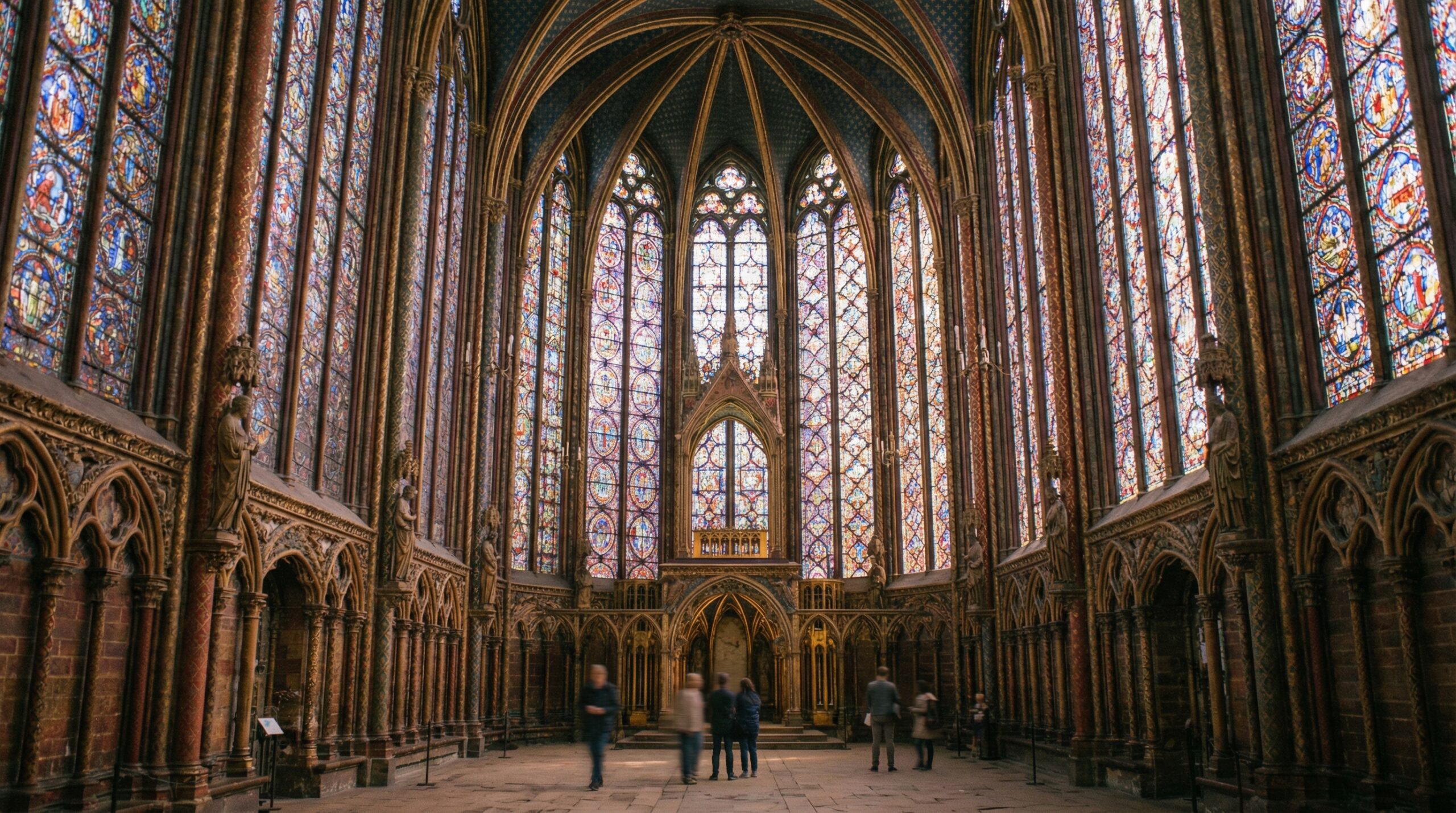
Nothing quite prepares you for the upper chapel. Walls composed of stained glass rather than stone surround you in every direction. The 15 windows each stand over 15 meters high. Together they cover approximately 600 square meters of surface area. Two thirds of the glass is original 13th-century work. This makes Sainte Chapelle one of the most intact examples of medieval glazing in the world.
The windows tell a sequential narrative from the Old and New Testaments. They depict more than 1,100 individual scenes. These scenes appear in horizontal bands that you read from bottom to top. The sequence begins with Genesis and moves through the books of the Bible. It concludes with scenes from the Apocalypse. It also includes references to the relics Louis IX brought to Paris. A large rose window sits at the western end. Workers added this in the 15th century during the reign of Charles VIII. It depicts scenes from the Book of Revelation.
Architectural Achievement and the Stained Glass App
The technical achievement of these windows is difficult to overstate. Gothic architects developed flying buttresses to move the roof weight away from the walls. This meant the walls did not need to carry structural loads. Builders at Sainte Chapelle took this principle to its limit. They reduced the walls to a very thin stone framework. They filled the remaining surface almost entirely with glass.
Artists produced the colored glass using mineral oxides fired into the material. This created vivid tones of cobalt blue, ruby red, gold, and green. These colors remain bright after nearly eight centuries. Sunlight enters from the east on clear mornings. The interior fills with colored light that moves across the floor as the sun climbs. You should download the official Sainte Chapelle Stained Glass app before your visit. It allows you to zoom into individual panels. It also provides descriptions of each scene. The app is useful because many details are too high to see without magnification.
Planning Your Visit to Sainte Chapelle Paris
Sainte Chapelle is located at 10 Boulevard du Palais, 75001 Paris. You can find it on the Ile de la Cité in the first arrondissement. The closest Metro station is Cité on Line 4. This is a two-minute walk from the entrance. You can also take the RER B or C to Saint Michel Notre Dame. This involves a slightly longer walk along the Seine.
From April 1 to September 30, the chapel is open daily from 9 am to 7 pm. Last entry is at 6:20 pm. From October 1 to March 31, the hours are 9 am to 5 pm. Last entry is at 4:30 pm. The site stays closed on January 1, May 1, and December 25. As of January 2026, tickets cost 16 euros for EU citizens and 22 euros for non-EU visitors. A combined ticket for Sainte Chapelle and the Conciergerie costs 23 euros for EU citizens and 30 euros for non-EU visitors. Entry is free for children under 18 and EU residents under 26. Paris Museum Pass holders enter for free but still need a timed entry reservation.
Security Procedures and Tips for Visitors
Sainte Chapelle sits within the Palais de Justice security perimeter. All visitors pass through a security check with airport-style screening. This can add waiting time during busy periods. Expect crowds between 10 am and 3 pm in spring and summer. Arriving at opening time or after 4 pm gives you the best chance of moving through quickly. Security prohibits bulky bags, glass bottles, aerosols, and sharp objects. They will not hold items that cannot go through the X-ray machine.
Most visitors spend between 30 and 45 minutes inside. Those who study the full biblical narrative often stay longer. The spiral staircase makes the upper chapel inaccessible by wheelchair. However, the lower chapel is fully accessible. The chapel has no heating system. This is important in winter when indoor temperatures feel very cold. Sainte Chapelle hosts classical music concerts throughout the year. The acoustics in the upper chapel are exceptional. Hearing Mozart or Vivaldi beneath those windows after dark is a unique experience.
Ready to see Sainte Chapelle Paris for yourself? Uncle Sam Tours offers guided Paris experiences. We bring these monuments to life with expert knowledge and seamless logistics. Visit Uncle Sam Tours to plan your trip today.