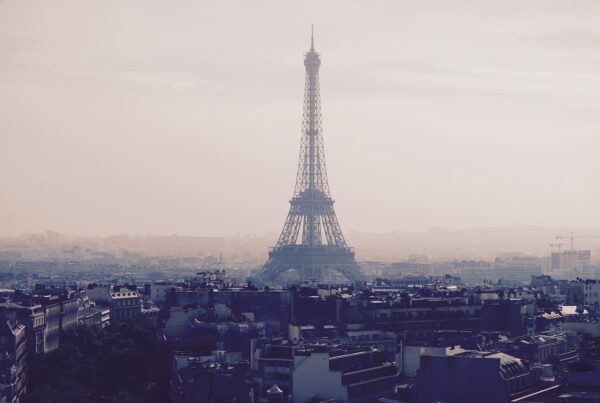

Most visitors at the base of the Eiffel Tower look upward. They see the lattice of iron beams rising into the Paris sky and feel the scale of the structure. However, few people think about the chain of decisions, calculations and physical labor that made the project possible. Gustave Eiffel defended his vision against fierce opposition and used high precision to complete the work. Understanding the history of Eiffel Tower construction changes how you see the monument today.
Early Planning and Design
The concept for the tower originated with two chief engineers in Gustave Eiffel’s firm. Emile Nouguier and Maurice Koechlin developed the idea in June 1884 for a metal pylon rising to 300 meters. Their first sketches showed four lattice columns separated at the base and tapering inward to meet at the top. Additionally, the design grew from metal viaduct work that the company had already completed across France.
The proposal entered a government competition in 1886 for the Exposition Universelle. More than 100 designs entered the contest and the commission selected Eiffel’s project above all others. Consequently, Eiffel signed a contract on January 8 1887. This agreement granted him 1.5 million francs toward construction costs. Because this was less than a quarter of the 6.5 million franc total, Eiffel funded the rest personally. In exchange, the city gave him the right to operate the tower commercially for twenty years.
The announcement caused immediate controversy. A group known as the Committee of Three Hundred formed in opposition to the project. This group included writers, artists and intellectuals who described the tower as a mistake. However, Gustave Eiffel argued that the mathematical curves of the uprights would create their own visual elegance. Construction began on January 28 1887 while the debate continued.
Logic Behind the Shape
The curved profile of the tower was a calculated response to wind. Eiffel and his team used graphical methods to determine structural needs at each level. Every section had to withstand wind forces so the team designed the upper half as if the lattice had no gaps.
The four uprights follow a curve that distributes wind load efficiently. Therefore, the tower sways by up to nine centimeters in strong wind. This flexibility allows the iron to avoid dangerous stress.
Additionally, the tower sits on a square base measuring 125 meters per side. Four lattice-girder piers rise from this base and join to form a single vertical column. While the four large arches at the base look important, they are decorative and carry no structural load. The curved legs also made standard elevators impossible. Consequently, Eiffel worked with the Otis Elevator Company to design hydraulic glass-cage elevators that ascend on a curve.
Managing Eiffel Tower Construction
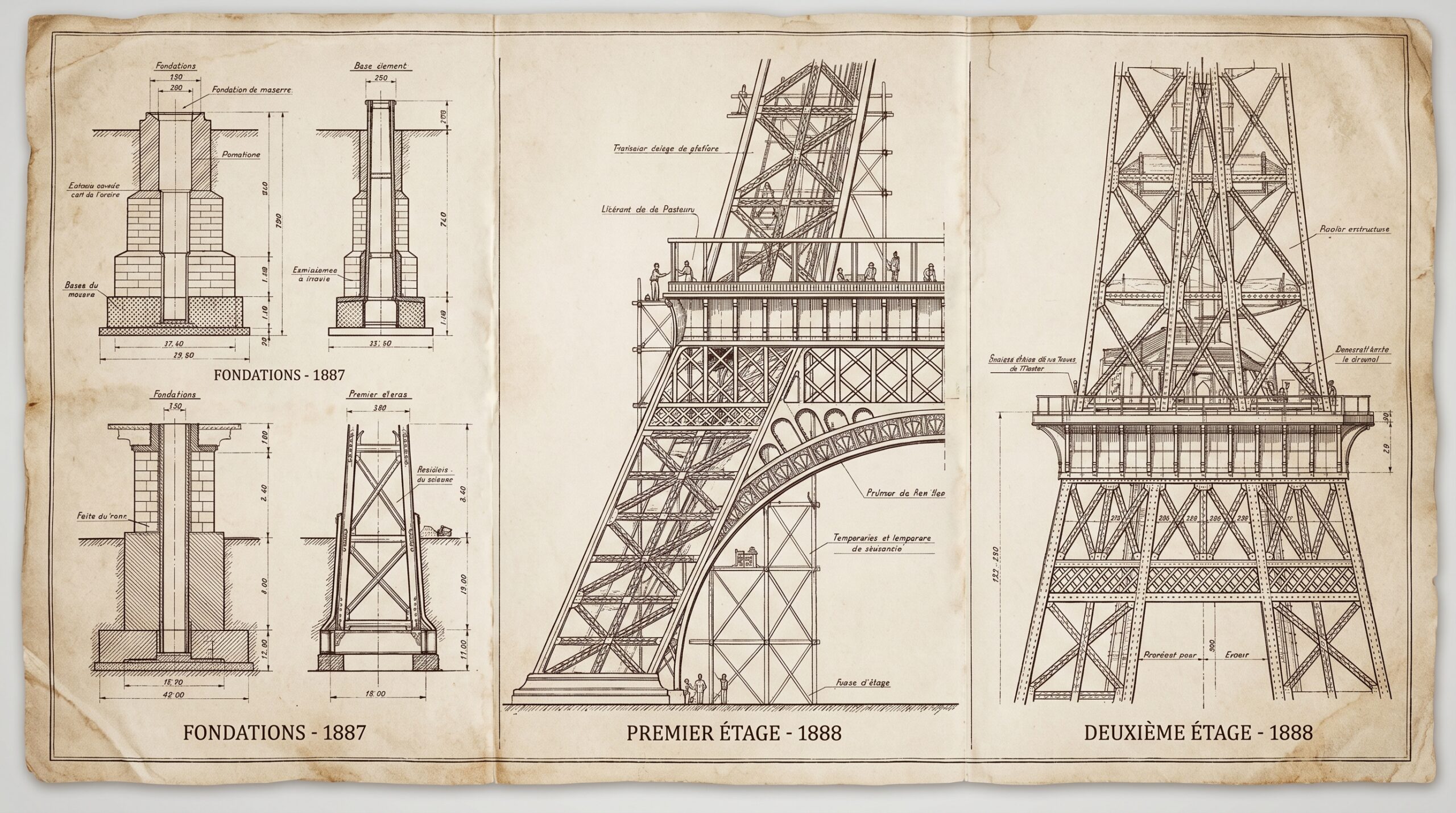
Physical construction ran from January 1887 to March 31 1889. The team achieved this speed by using prefabrication. Every component was built at the factory in Levallois-Perret before arriving at the site. All 18,038 individual parts were accurate to within one tenth of a millimeter. Similarly, the position of each rivet hole was accurate to within one millimeter. No drilling or shaping took place on site.
Horse-drawn carts delivered the components to the site. Workers first bolted the parts together and later replaced the bolts with permanent rivets. Of the 2.5 million rivets used in Eiffel Tower construction, the factory pre-assembled two thirds of them. Between 150 and 300 workers were on site at any time and the project recorded no deaths.
Foundations for the two piers near the Seine required pressurized work to manage the water table. The legs grew as cantilevered extensions and construction paused to install timber scaffolds. This pause generated headlines claiming the project was failing. However, the scaffold was a standard precaution and construction continued. The four legs joined at the first level in March 1888 and the summit was reached by March 1889.
Materials and Color History
Gustave Eiffel chose puddled iron from the Pompey forges for the project. This refining process removes carbon to produce a metal that is consistent and resistant to fractures. To protect the iron from rust, teams apply a thick protective coat of paint. Workers repaint the tower every seven years. This task requires 60 tonnes of paint and 15 months of physical labor.
The color of the tower has changed many times. When the factory first built the components, they applied a Venetian red paint. For the 1889 opening, the tower became reddish-brown. Later, in 1899, workers applied five tones of yellow-orange in a gradient. The current shade is a bronze tone known as Eiffel Tower Brown.
Experience the Story in Person
A guided tour helps you notice things that most visitors walk past. You can see the curve of the uprights and the logic behind the lattice pattern. If you want to see these engineering feats up close, check out our other Tours for more inspiration.
Uncle Sam Tours offers guided visits with reserved entry and English-speaking guides. They cover the full history of Eiffel Tower construction and the engineering decisions that shaped the monument. The Eiffel Tower Climbing Tour with Summit Access takes you up the iron staircase through the structure. Groups are small and timed entry is secured in advance so you can spend your time at the monument rather than in a queue.