
Notre Dame Cathedral Paris has stood on the Ile de la Cite for more than 860 years. It survived revolutions, wars, and deliberate destruction, and in April 2019 it came closer to permanent loss than at any point in its history. The fire that tore through its roof that evening was watched live by millions of people around the world. Five years later, after one of the largest restoration efforts in modern history, it reopened. What stands today is the same building it always was and, in many ways, more visible in its original form than most living people have ever seen.
This covers the full story of how Notre Dame was built, what it contains, what the fire actually destroyed, and what you will find when you walk inside today.
How Notre Dame Cathedral Paris Was Built
Construction of Notre Dame began in 1163 under Bishop Maurice de Sully, who wanted to replace two older churches that stood on the same site on the Ile de la Cite. Before those churches, the ground had held a Roman temple dedicated to Jupiter. Sully envisioned a cathedral unlike anything Paris had seen, and he brought together the best stone masons and architects available to realize it.
The foundation stone was laid in 1163 in a ceremony attended by Pope Alexander III. The high altar was consecrated in 1189. The choir, the western facade, and the nave were largely completed by 1250, and further work on chapels and decorative elements continued through the following century. The construction spanned nearly two hundred years from start to finish and involved generations of craftsmen whose individual names have mostly been lost to history.
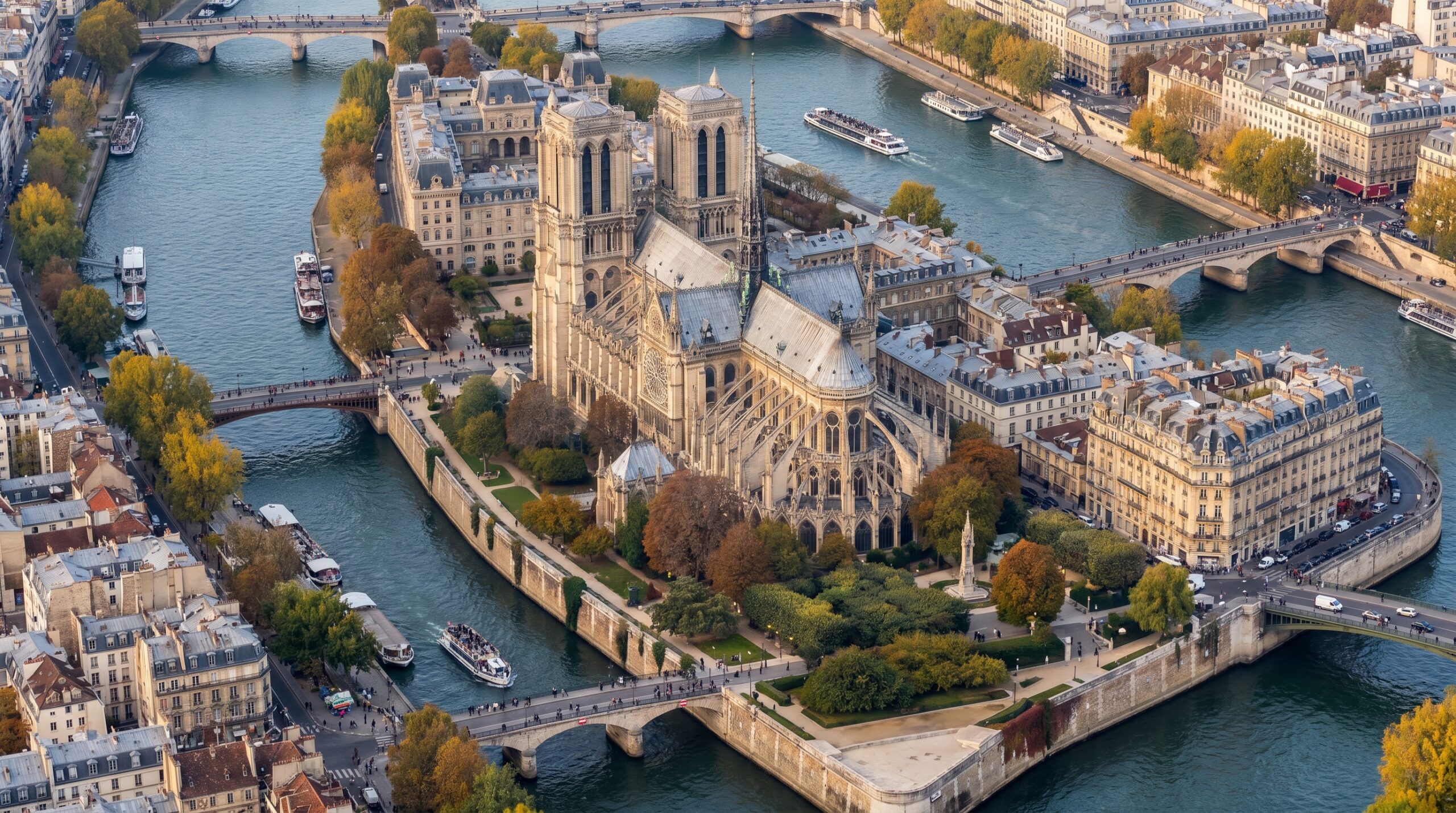
What made Notre Dame architecturally significant at the time was not just its scale, but the engineering behind it. The cathedral was built according to the principles of Gothic architecture, which allowed for taller walls and far larger windows than earlier Romanesque buildings. The key innovation was the flying buttress, an arched external support that transfers the weight of the heavy roof outward rather than downward, freeing the interior walls to hold glass rather than solid stone. Notre Dame is among the earliest large buildings in the world to use flying buttresses this way, and you can see them clearly along the exterior today.
The interior measures 128 metres long and 48 metres wide. The nave reaches 35 metres at its vault. The two western towers rise 69 metres above the ground. These are not abstract figures once you are standing inside, because the scale is immediately felt in a way that no photograph prepares you for.
Victor Hugo and Why the Building Nearly Disappeared
By the early 19th century, Notre Dame was in serious physical decline. The French Revolution had caused severe damage to the building in the 1790s, during which large amounts of religious imagery were destroyed and the cathedral was repurposed for secular functions. Statues were pulled down, the original medieval bells were melted, and much of the sculpted decoration was damaged or removed.
The building was in such poor condition by the 1830s that demolition was actively considered. What saved it, in large part, was a novel. Victor Hugo published Notre-Dame de Paris in 1831, using the cathedral as the dramatic setting for the story now widely known as The Hunchback of Notre-Dame. The novel drew public attention to the state of the building and created a wave of sentiment in favor of saving it. Hugo himself signed a petition for its restoration in 1842.
Restoration work began in 1844 under architect Eugene Viollet-le-Duc, who oversaw one of the most ambitious conservation projects of the 19th century. Viollet-le-Duc restored the facade sculptures, redesigned the sacristy, and added the distinctive spire above the crossing of the transept, which replaced an original medieval spire that had been removed in the 18th century due to instability. The chimera sculptures on the gallery level, the ones most people associate with the word gargoyles, were also added by Viollet-le-Duc during this period. They are not medieval originals but 19th century interpretations that have since become inseparable from how most people picture the cathedral.
This distinction matters more than most visitors realize. The creatures sitting on the gallery level are technically chimeras, not gargoyles. A gargoyle is a functional drainage feature designed to throw rainwater away from the walls. The chimeras are purely decorative. The Uncle Sam Tours guide on gargoyles and chimeras at Notre Dame explains this difference and what it tells us about how the cathedral was understood in the 1800s.
The 2019 Fire and What Was Lost
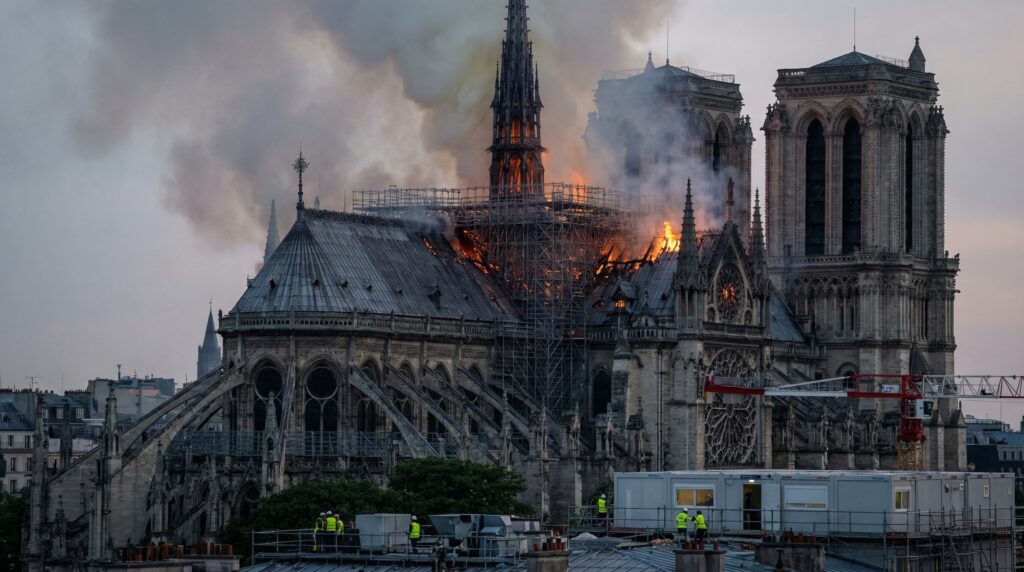
On the evening of April 15, 2019, a fire broke out in the attic of Notre Dame Cathedral at approximately 6.50 pm local time. The cause is believed to have been accidental, most likely connected to electrical issues or a cigarette from workers involved in the ongoing restoration campaign underway at the time. The exact cause was never officially confirmed.
The fire spread rapidly through the wooden roof structure, which dated to the 12th and 13th centuries. The original medieval timber construction, known as the Forest because of the sheer quantity of wood involved, had been built using around 5,000 oak trees. Some of those beams had held the roof for 800 years. The fire consumed most of that structure within hours. At 7.53 pm, the 19th-century spire collapsed as crowds of Parisians watched from the banks of the Seine.
The fire destroyed roughly two-thirds of the roof and caused the spire to fall entirely. The rib vaulting in parts of the ceiling was also damaged. Three of the cathedral’s notable stained glass windows were destroyed in the heat. The stone structure of the building, the towers, the walls, and the famous rose windows survived. The Crown of Thorns and other relics from the Treasury were evacuated by a human chain of firefighters and cathedral staff and were undamaged.
President Emmanuel Macron announced the same night that France would rebuild Notre Dame within five years. At the time, many experts considered this timeline impossible.
The Restoration that Followed
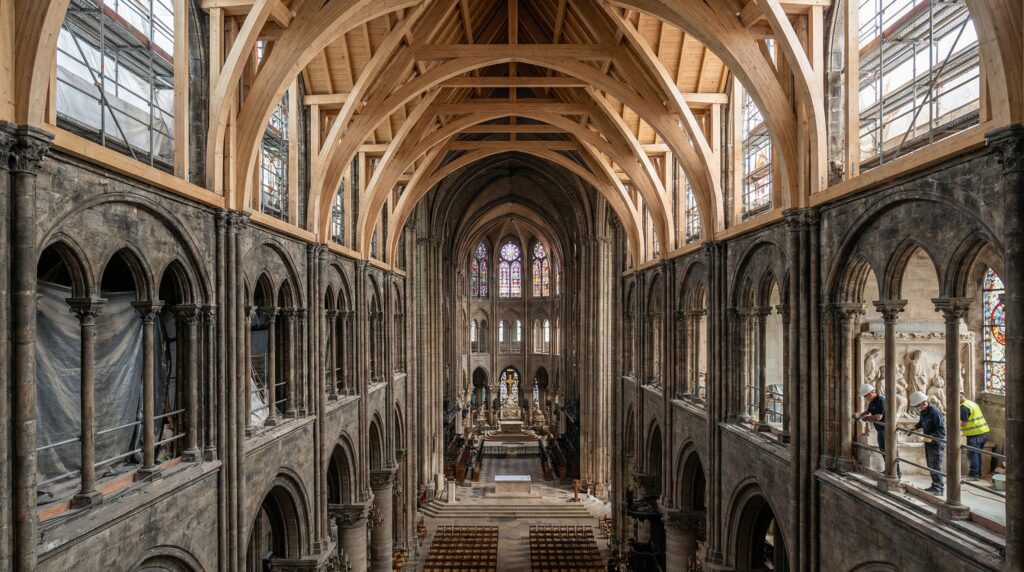
The restoration was one of the most technically complex heritage conservation efforts in modern history. At its peak, around 2,000 craftspeople were working on the project simultaneously, including stonemasons, carpenters, glassmakers, and specialists in medieval construction techniques.
The decision was made to rebuild the cathedral as close to its pre-fire state as possible rather than change any element. The spire was reconstructed using the same design and traditional materials, and carpenters rebuilding the roof structure used hand tools replicating medieval methods. In some cases, this meant reviving techniques that had not been practiced for generations.
The rebuilt timber roof, still called the Forest, is one of the more remarkable parts of the whole project. The Uncle Sam Tours article on the Lost Forest at Notre Dame covers the detail of how carpenters sourced and worked the timber to match what the original builders had done eight centuries earlier.
The restoration also involved a full cleaning of the stone interior walls and the stained glass, removing accumulated grime from surfaces that in some cases had not been properly cleaned since the 19th century. The cathedral officially reopened on December 7 and 8, 2024, meeting the five-year deadline that had seemed so unlikely on the night of the fire.
What Notre Dame Cathedral Paris Looks Like Today
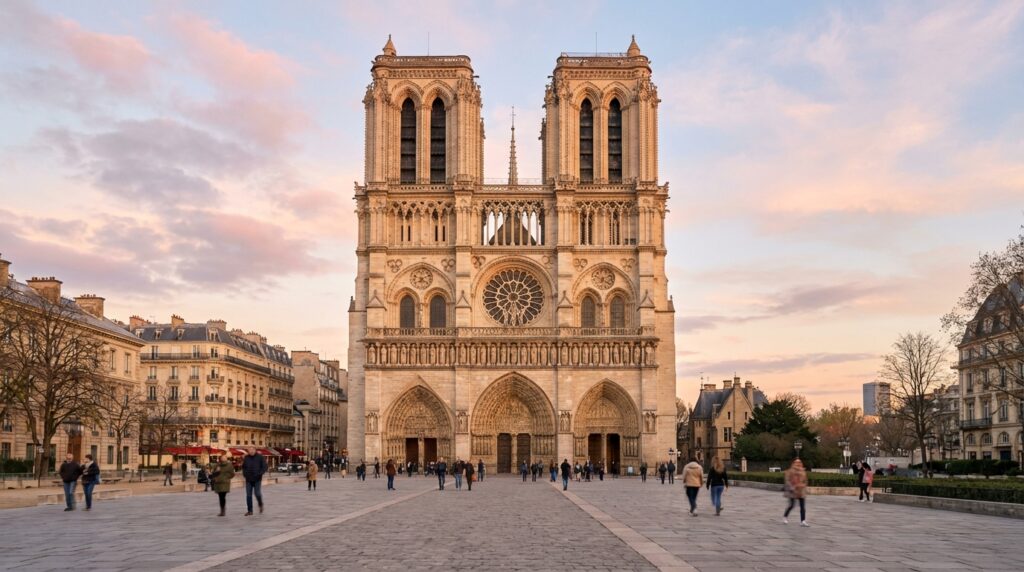
The interior today looks different from most photographs people have seen of the building. The cleaning revealed the warm cream color of the original limestone, which had been darkened over centuries. The stained glass windows, with the accumulated grime removed, now show the colors that their medieval makers intended.
The three rose windows are among the most significant features inside. The north rose window dates to the 13th century and is one of the finest examples of Gothic stained glass anywhere in Europe. Each window was designed as a theological arrangement, telling specific biblical stories through imagery set in precise symbolic patterns. The cleaning process revealed details in the glass that had been obscured for generations.
The rebuilt spire is visible again above the Paris skyline, reconstructed to match Viollet-le-Duc’s 19th-century design. The rooster at the top of the spire, a traditional feature of French church architecture, was restored on December 16, 2023, before the reopening.
The Bell Towers reopened in September 2025 with a new visitor route that includes the largest wooden double-helix staircase in the world, constructed during the restoration. The two main bells, Emmanuel and Marie, rang publicly in July 2025 for the first time since the fire.
Just outside the main entrance, embedded in the cobblestones of the forecourt, sits Point Zero, a small brass star marking the official geographic center of France from which all road distances in the country are measured. Most visitors walk past it without noticing. The Uncle Sam Tours article on Point Zero near Notre Dame explains what it marks and why it is worth a few seconds of your attention.
Why This Matters When You Visit
Understanding the history of Notre Dame Cathedral Paris before you walk through the door changes what you notice inside. The cleaned limestone tells a story about the fire and the restoration. The chimeras on the tower balcony tell a story about the 19th century’s ideas about the Middle Ages. The rose windows are a record of what medieval theologians and craftsmen believed about light, color, and the structure of sacred space. The rebuilt Forest above your head is a record of what it took to bring the building back after 2019.
The Notre Dame tours run by Uncle Sam Tours are conducted in English by expert guides who cover the history, architecture, the fire, and the restoration, highlighting details that many visitors often overlook. Tour includes scheduled access with semi private group option.