
The Louvre welcomed nine million visitors in 2025, which remains an unmatched figure in the global art world. According to the Art Newspaper’s annual global museum attendance survey published in March 2026, the Natural History Museum in London drew 7.1 million people while the Vatican Museums followed in second place with 6.9 million visitors. Other major institutions such as the British Museum drew 6.4 million people and the Metropolitan Museum of Art in New York drew approximately 6 million visitors. None of these renowned institutions have come close to the Louvre’s attendance numbers and they have not for many years.
This trend has been the consistent pattern across several decades rather than a single exceptional season. In 2018, before the pandemic disrupted global travel, the Louvre set an all-time record with 10.2 million visitors. Although attendance fell to 2.7 million in 2020 during the closures, it climbed back to 7.7 million in 2022 and continued rising to 8.9 million in 2023. The museum maintained this momentum with 8.7 million visitors in 2024 and 9 million in 2025. Consistent demand at such a massive scale does not result from a single reason because it arises from a specific combination of history, location, collection and cultural presence that no other institution has fully replicated.
How the Louvre Existed for Nine Centuries Before It Became a Museum
From Fortress to Royal Palace
King Philip II started the Louvre as a fortress in the late 12th century. He built it to defend Paris from western attacks. The original structure featured a moat, watchtowers and thick walls. Paris expanded outward over the following centuries. The fortress lost its military purpose and became a royal residence. Charles V turned it into a Gothic palace in the 14th century. Francis I rebuilt sections as a Renaissance palace in the 16th century. He also acquired Leonardo da Vinci’s Mona Lisa for his personal collection.
The Transition to a National Museum
Louis XIV moved the royal court to Versailles in 1682. The Louvre sat without a clear function for over a century. It primarily housed the royal art collection and provided studio space to artists. The French Revolution changed its status permanently. The Louvre opened as a national museum in 1793. The royal art collection became accessible to the public. Napoleon Bonaparte later expanded the collection through military campaigns. Many items returned home after 1815 but a significant portion stayed. By the 19th century, the Louvre held a depth of objects that no other institution had assembled.
What Is Actually Inside the Louvre Museum
The Louvre holds approximately 500,000 objects. Around 38,000 items are on display across 72,735 square metres. It is the largest museum in the world by area. Eight curatorial departments span everything from Egyptian Antiquities to Islamic Art. The Egyptian collection alone contains more than 50,000 artefacts. These items cover the period from 4,000 BC to the 4th century AD.
The Near Eastern collection includes the Law Code of Hammurabi. This document dates to 1754 BC and is one of the oldest legal texts. The Greek and Roman galleries hold globally recognised sculptures. The Smithsonian is technically larger as a system but uses nineteen separate museums. The British Museum collection is roughly half the size of the Louvre’s. Walking the full Louvre in one visit is not a realistic goal. The building is simply too large and the collection is too dense.
The Two Artworks That Pull Millions of Visitors
The Celebrity of the Mona Lisa
Leonardo da Vinci painted the Mona Lisa between 1503 and 1519. Francis I acquired it for the royal collection. French heritage law now permanently prohibits its sale. The museum displays it behind bulletproof glass in the Salle des Etats. Data suggests the painting draws approximately 7 million visitors each year.
A theft actually created the painting’s global celebrity. Vincenzo Peruggia hid inside the museum overnight in 1911. He walked out the next morning with the painting under his coat. The resulting media coverage increased its recognition more than any study. The public response was enormous when it returned in 1914.
The Mystery of the Venus de Milo
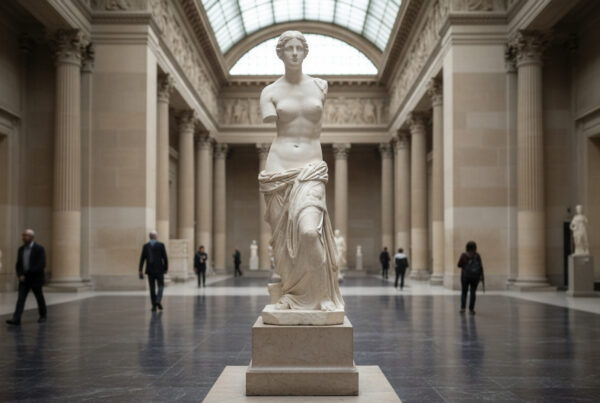
The Venus de Milo was discovered on the island of Milos in 1820. France acquired it shortly after and Louis XVIII presented it to the museum. The sculpture stands just over 2 metres tall and dates to the 2nd century BC. It likely depicts Aphrodite, the goddess of love. The missing arms were never recovered. This absence became the most discussed aspect of the work. The mystery of the pose has sustained public interest for two centuries. Both works give the Louvre a concentration of iconic art that no other institution holds.
Why Paris Gives the Louvre a Unique Advantage
The Louvre sits in one of the most visited cities in the world. Paris drew approximately 47 million international tourists in 2024. Most first-time visitors treat the Louvre as a default stop. Museum data from 2024 shows that 66 percent of visitors were there for the first time. Tourism consistently feeds these attendance numbers.
The museum is very accessible via two Metro lines. The Palais Royal station offers direct underground entry. It sits next to the Tuileries Garden and near the Seine. Most tourists reach the Louvre with very little effort. It falls naturally within the geography of central Paris. Newer or remote museums cannot manufacture this advantage. Paris and the Louvre reinforce each other in a way that is difficult to replicate.
The Glass Pyramid and Future Renovations
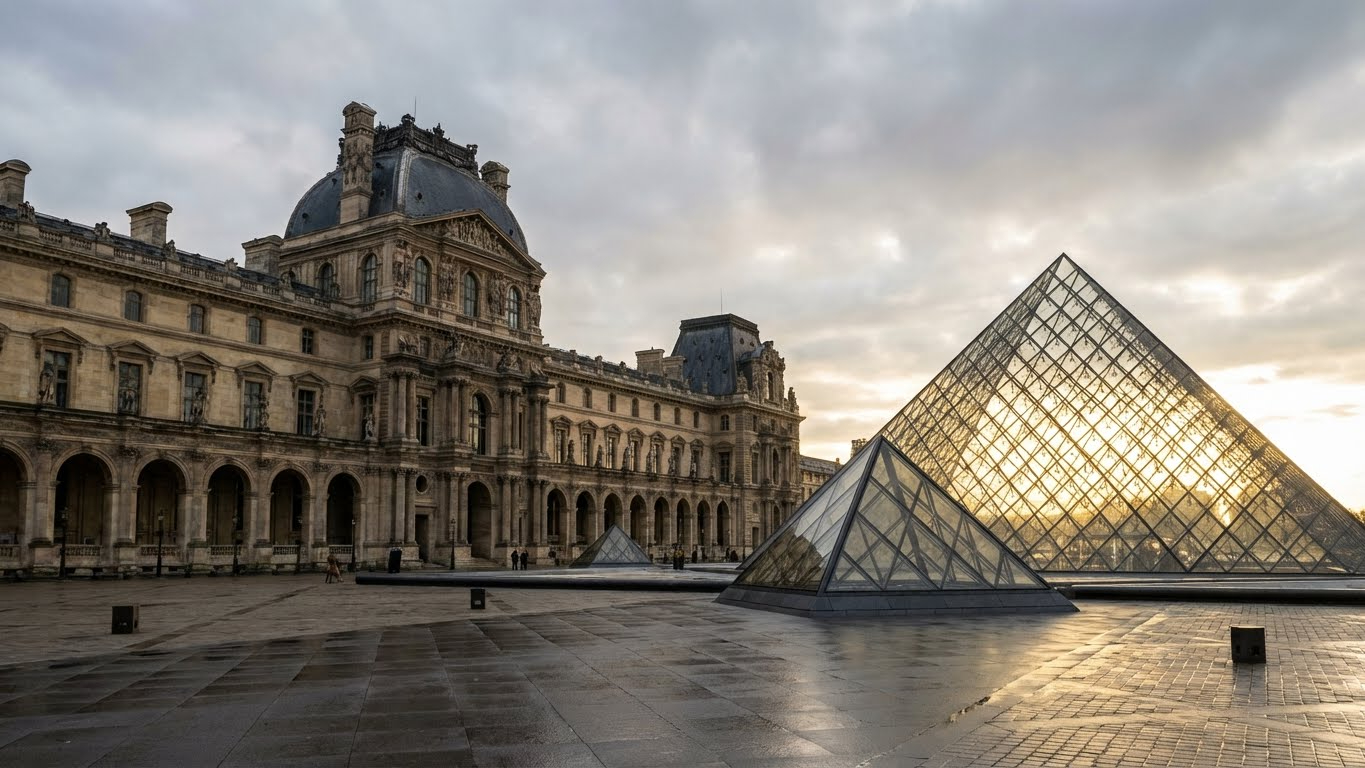
French President Francois Mitterrand commissioned a major renovation in the 1980s. This “Grand Louvre” project featured a glass and steel pyramid. I.M. Pei designed the structure and it opened in 1989. An underground complex contains ticketing, shops and parking. Many people criticised the modern pyramid at first. However, it solved a genuine operational problem.
The original entrance could not handle the growing visitor numbers. The underground complex added 60,000 square metres of space. The pyramid is now one of the most photographed structures in Paris. President Emmanuel Macron announced another renovation plan in January 2025. High visitor volume drives this new expansion. The plan includes a dedicated room for the Mona Lisa. This will address overcrowding in the Salle des Etats. Construction will begin in September 2026.
How Pop Culture Feeds the Global Profile
Pop culture actively pulls in visitors who might not otherwise visit an art museum. Dan Brown’s The Da Vinci Code sold over 80 million copies. The book used the Louvre as a central setting. Ron Howard filmed portions of the movie adaptation inside the Denon Wing. Visitor numbers rose noticeably in 2005 due to the book’s popularity. Attendance reached 7.3 million that year. The museum even created an official tour for fans of the book.
Films like Bande à Part and Wonder Woman have featured the museum. Beyonce and Jay-Z filmed their Apesht* music video inside the Louvre in 2018. It featured the Mona Lisa and other permanent works. The video accumulated hundreds of millions of views. It generated massive social media discussion. This placed the museum in a context that felt current to new audiences. The Louvre is a visually distinctive setting that signals cultural weight.
Why Temporary Exhibitions Keep Drawing People Back
Blockbuster Spikes
The permanent collection draws people reliably but exhibitions drive specific attendance spikes. A major Leonardo da Vinci retrospective took place in 2019. That single exhibition drew over 1.1 million visitors. It contributed to a record 9.6 million total visitors that year. The Masterpieces from the Torlonia Collection drew 705,000 people in 2024. The Olympism exhibition drew 336,000 visitors during the Paris Olympic Games.
Strategic Planning
These shows give Parisians and repeat visitors a reason to return. A major exhibition can shape the timing of an international trip. The Louvre runs several exhibitions each year alongside its permanent collection. This keeps the museum in travel planning calendars and public conversation.
Overcrowding as a Signal of Demand
The Louvre has struggled with its own popularity for years. Museum employees went on strike in June 2025. They cited overcrowding and untenable working conditions. The museum has capped daily admissions at 30,000 tickets since 2022. Before the pandemic, up to 45,000 visitors entered on busy days. Timed entry is now mandatory for all visitors.
The Prado Museum’s director called the Louvre a cautionary example in 2026. He stated the Prado had no interest in growing beyond 3.5 million visitors. Despite this comparison, the Louvre gained visitors year over year. Seeing the Mona Lisa at peak hours means standing in a dense crowd. The experience varies based on when you go and how you plan.
What the Visitor Numbers Reveal
In 2024, 77 percent of visitors were international tourists. Americans represented the single largest source country. French visitors made up the remaining 23 percent. Survey data from 2024 shows 92 percent of visitors were satisfied. This satisfaction remained high despite scale and crowd challenges.
These numbers show how consistent the Louvre’s global pull is. Nearly three quarters of visitors travelled from another country. The museum is not sustained by local interest alone. It operates on an international audience that rebuilds every year.
How to Visit the Louvre Without Regret
Practical Logistics
Visiting without planning produces a frustrating experience. You must purchase tickets online through the official website. Walk-up entry is unreliable and risky during peak months. The museum is open every day except Tuesday. Wednesday and Friday evenings include extended hours until 9:45 pm. These sessions are noticeably less crowded than daytime visits. Early mornings on weekdays are also a good choice.
Navigating the Space
The building features three main wings: Denon, Richelieu and Sully. The Mona Lisa sits in the Denon Wing. The Venus de Milo is in the Sully Wing. Do not try to cover the entire museum in one visit. Choosing two or three departments produces a better experience. You can see the medieval foundations of the original fortress in the Sully Wing. These are often undervisited. Napoleon III’s royal apartments in the Richelieu Wing are also worth a detour.
Why No Other Museum Has Closed the Gap
The Louvre’s position rests on factors that took centuries to build. Royal patronage stretching back to the 16th century assembled the collection. The building’s history as a fortress and palace gives it unique significance. Iconic works are permanently resident in Paris by law. The city draws tens of millions of tourists who visit the Louvre as a matter of course.
Newer institutions have achieved real success. The Shanghai Museum East drew 4.6 million in 2025. The National Museum of Korea reached 6.5 million visitors in 2025. However, none have the Louvre’s combination of history and globally recognised works. It holds its position because of what it contains and where it sits. The museum is deeply embedded in the global imagination.
Experience the Louvre Without the Overwhelm
Uncle Sam Tours offers guided Louvre experiences designed to cut through the common friction points of visiting. These include curated routes, context for what you are actually looking at and access to parts of the museum most solo visitors walk past without realising what they are missing.
If you are planning a Paris trip and want to read more before you go, our other posts cover the full Paris first-timer guide, a breakdown of how the Vatican Museums compare to the Louvre, the complete story of the Mona Lisa theft and what it did to art history and crowd timing strategies for the biggest museums in Europe.