
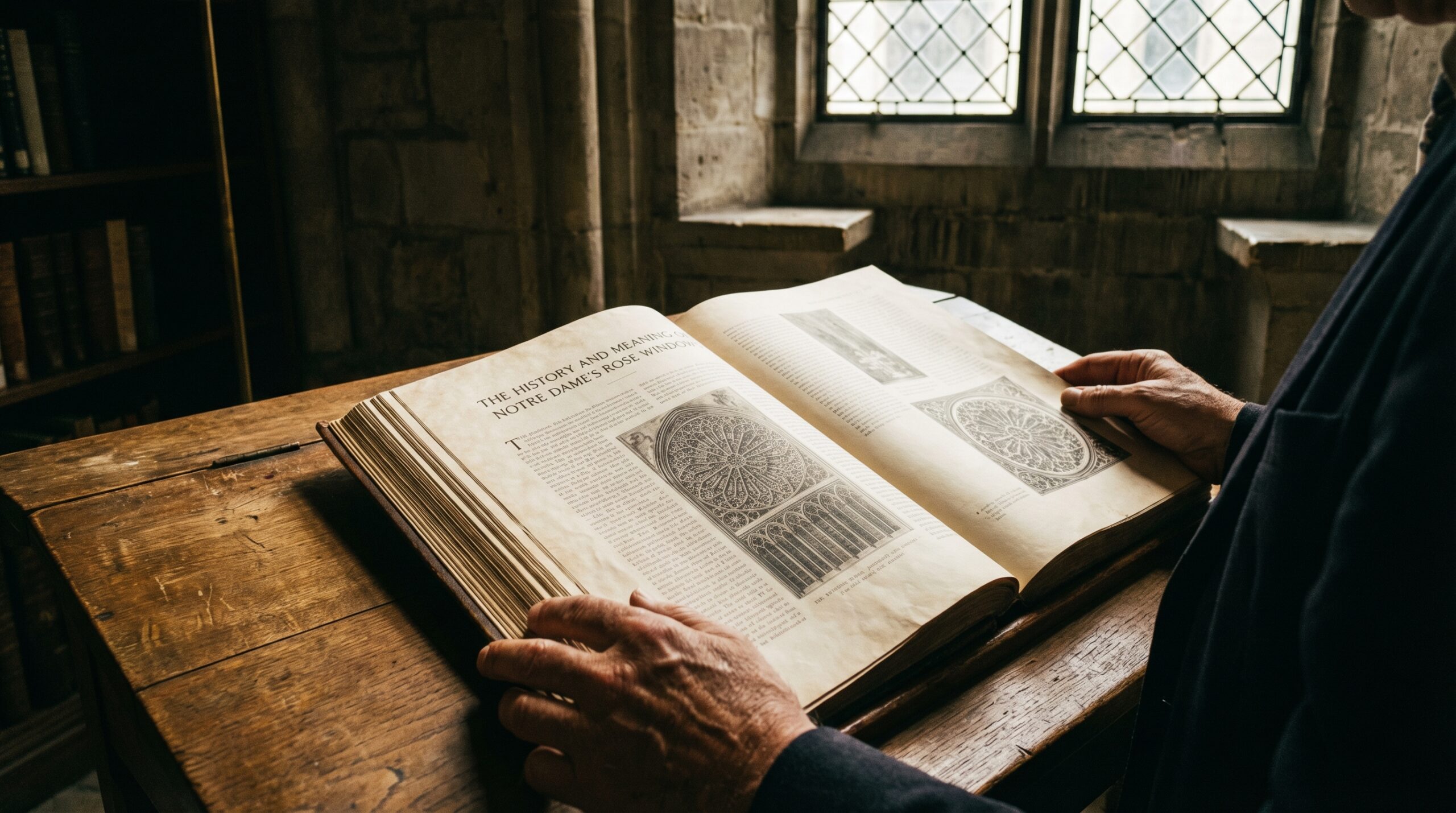
Most people entering Notre Dame Cathedral look straight ahead toward the altar. The nave draws your eye forward. That is the natural reaction. What most visitors miss, at least until a guide points it out, is what sits above them and to both sides. The three rose windows of Notre Dame Cathedral are among the most significant works of medieval art in the world. They are not decoration. They were designed to communicate specific ideas to everyone who entered, regardless of whether they could read. Understanding what each window says changes the entire experience of being inside the cathedral.
Why Gothic Builders Made Windows Out of Stone and Glass
Before you can understand what the Notre Dame rose windows mean, it helps to understand why they exist at all. Gothic architecture in the 12th and 13th centuries solved a structural problem in a way that created a spiritual opportunity. Earlier Romanesque churches required thick, heavy walls to support their roofs. Those walls had very little room for windows.
Gothic builders invented two tools that changed everything. These were the pointed arch and the flying buttress. By transferring the weight of the roof outward and downward through these external stone arms, the builders could replace solid wall with glass.
The theological reasoning behind this came from Abbot Suger. He rebuilt the Basilica of Saint-Denis near Paris in the 1140s. He believed that physical light could guide a person toward divine light. Colored glass was not considered decoration in this tradition. It was considered a bridge between the earthly world and the heavenly one. By the time construction began on Notre Dame Cathedral in 1163, this philosophy had spread throughout French architecture.
The rose window became its most powerful expression. A large circle of glass cutting through a wall that supports tons of stone is one of the defining achievements of Gothic engineering. The interlocking stone tracery within the circle distributes the weight across the opening while holding the glass panels in place.
The West Rose Window
The oldest of the three Notre Dame rose windows sits above the main entrance on the western facade. It was completed around 1225. This made it the largest rose window in the world at the time of its creation. It measures approximately 9.6 meters in diameter. That record did not last long. The larger transept windows that followed within a few decades surpassed it.
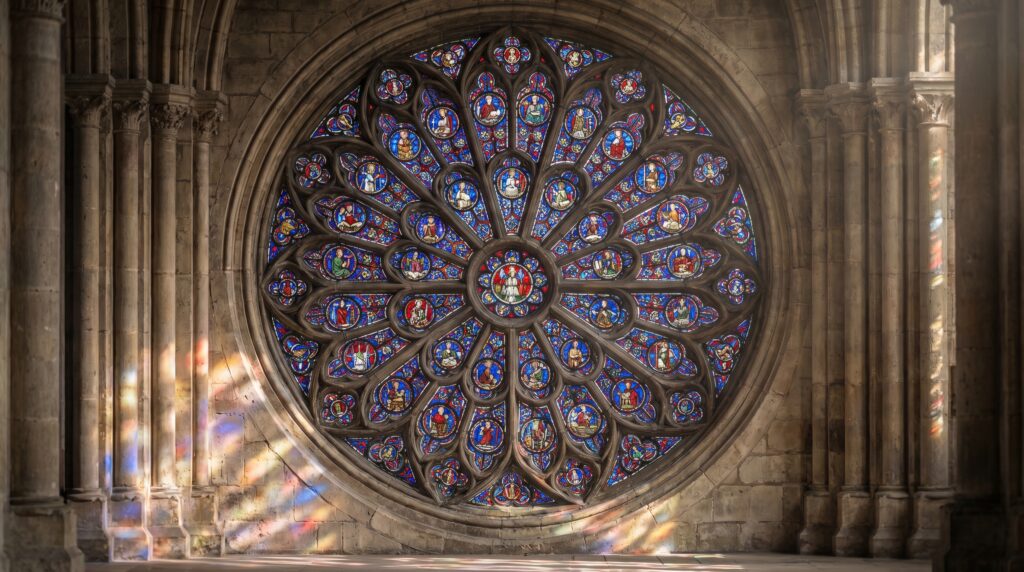
None of the original medieval glass in the west rose survives today. The window was entirely reconstructed during the 19th-century restoration led by architect Eugène Viollet-le-Duc. The composition of the west rose window centers on the Virgin and Child. Around this central image, the design moves outward in concentric circles.
The first circle represents the twelve tribes of Israel. The upper half of the window depicts virtues and vices shown in pairs. The lower half shows the twelve signs of the zodiac linked to the labors of the months throughout the year. This combination of sacred and seasonal imagery was deliberate. It placed human life, including its spiritual dimensions and its physical rhythms, within a single visual framework. The placement above the main entrance was also deliberate. Visitors entering the cathedral through the western portal passed beneath a complete picture of the moral and cosmic order before stepping inside.
The North Rose Window
The north rose window was completed around 1250 and sits in the left transept arm of the cathedral. At approximately 12.9 meters in diameter, it is significantly larger than the western window. It holds the distinction of being the only one of the three windows to retain a majority of its original 13th-century glass. This is a remarkable fact given the fires, wars, and political upheavals the cathedral has survived over the past eight centuries.
The color of the north window is primarily blue. This was not arbitrary. Blue was the color associated with the Virgin Mary in medieval Christian symbolism. The central image of the north rose window shows Mary enthroned and holding the Christ Child. This composition is known as the Theotokos or God-bearer. The surrounding panels depict figures from the Old Testament. These include judges, kings, and prophets who were understood as anticipating the coming of Christ.
This theological structure reflects a very specific medieval reading of scripture. The window was positioned on the north side because the north receives less direct sunlight in northern Europe. Blue glass was known to read particularly well in diffuse light. The preservation of this original glass has given art historians an invaluable reference point. When the fire of April 2019 sent flames through the cathedral roof, the world held its breath. All three rose windows emerged intact. The stone vaulting directly below the windows absorbed most of the thermal shock. Conservators still had to clean each window afterward due to toxic lead dust and structural vibrations, but the glass itself was not destroyed.
The South Rose Window
The south rose window, completed around 1260, is generally regarded as the most visually dramatic of the three. Its diameter of approximately 13 meters makes it the largest of the Notre Dame rose windows. It glows in deep reds and golds rather than blues. This reflects its placement on the south side of the cathedral where it receives the strongest afternoon sunlight. It also reflects the theological message it carries.
The south rose was a gift from King Louis IX of France. He was later canonized as Saint Louis. It was built in two phases, first by architect Jean de Chelles and then completed by Pierre de Montreuil. The composition of the south rose window places Christ in the center surrounded by angels. The surrounding circles depict saints, apostles, bishops, martyrs, and witnesses. These are arranged across 84 individual panels organized around the symbolic numbers four, twelve, and twenty-four.
The twelve apostles occupy the inner two circles. The theme of the window is the Last Judgment and the New Testament. This forms a deliberate counterpart to the Old Testament narrative of the north window across the transept. Standing in the crossing of the cathedral, a visitor sees the entire arc of the biblical story told in colored light. The blue Old Testament narrative to the left answers the red New Testament glory to the right. The nave stretches between them.
The south rose window has required more restoration work than its counterparts over the centuries. Color stability problems appeared as early as the 15th century. Between 1725 and 1727, Cardinal de Noailles financed a significant reconstruction. During the 19th-century restoration, the master glassmaker Alfred Gérente left the 18th-century additions in place. He reconstructed missing medallions in a medieval style drawn from the windows at Chartres Cathedral.
What Visitors See Today and When to Look
Visiting Notre Dame Cathedral after its December 2024 reopening means seeing these windows in a newly restored interior. The cleaning and conservation work removed centuries of accumulated soot and grime from the stone and the glass. The windows are brighter and more legible now than they have been in living memory. Visitors who saw them before 2019 report that the colors read with a clarity that was not possible in the darkened pre-fire interior.
The time of day matters for your experience. The north rose window reads best in the morning when the diffuse northern light illuminates the blues evenly. The south rose window reaches its full intensity in the early to mid afternoon when direct sunlight floods through the reds and golds. The west window above the entrance catches the late afternoon and evening light.
If you have the flexibility to time your visit, arriving in the early afternoon allows you to experience both the north and south windows while the light is favorable. A guided tour of Notre Dame makes a significant difference here. The specific theological programs of each window require explanation. Without knowing what you are looking for, even the most attentive visitor will miss the systematic structure that connects the three windows into a single coherent visual argument.
Why These Windows Matter Beyond Their Beauty
The Notre Dame rose windows are often described in terms of their visual impact. This impact is genuine and immediate. They are extraordinary to look at. The more important point is that they functioned as a complete educational and theological system. They were built for an era when the majority of people who entered this cathedral could not read text. The builders understood that light, color, and position could carry meaning across an entire population.
The circle itself carried meaning. Medieval thinkers associated the circle with divine perfection because it has no beginning and no end. The symmetry of the rose window reinforced the idea of a universe governed by order and intention. The survival of these windows through the French Revolution and two world wars speaks to something beyond good fortune.
The stone engineering that protected them was designed with extraordinary precision. The fact that the 13th-century glass of the north window can still be seen today places visitors in direct visual contact with the hands that made it nearly 800 years ago. That is not a common experience anywhere in the world.
Planning a visit to see the Notre Dame rose windows means going with enough context to read them properly. The Notre Dame guided tours offered by Uncle Sam Tours are led by licensed guides. They cover the history, the symbolism, and the architectural engineering of these windows as part of a complete experience. If you want reserved timed entry to enter at the right time of day, the Notre Dame reserved entry tour is the most effective way to plan your visit. Book your place before your trip to Paris to secure your preferred time slot.