
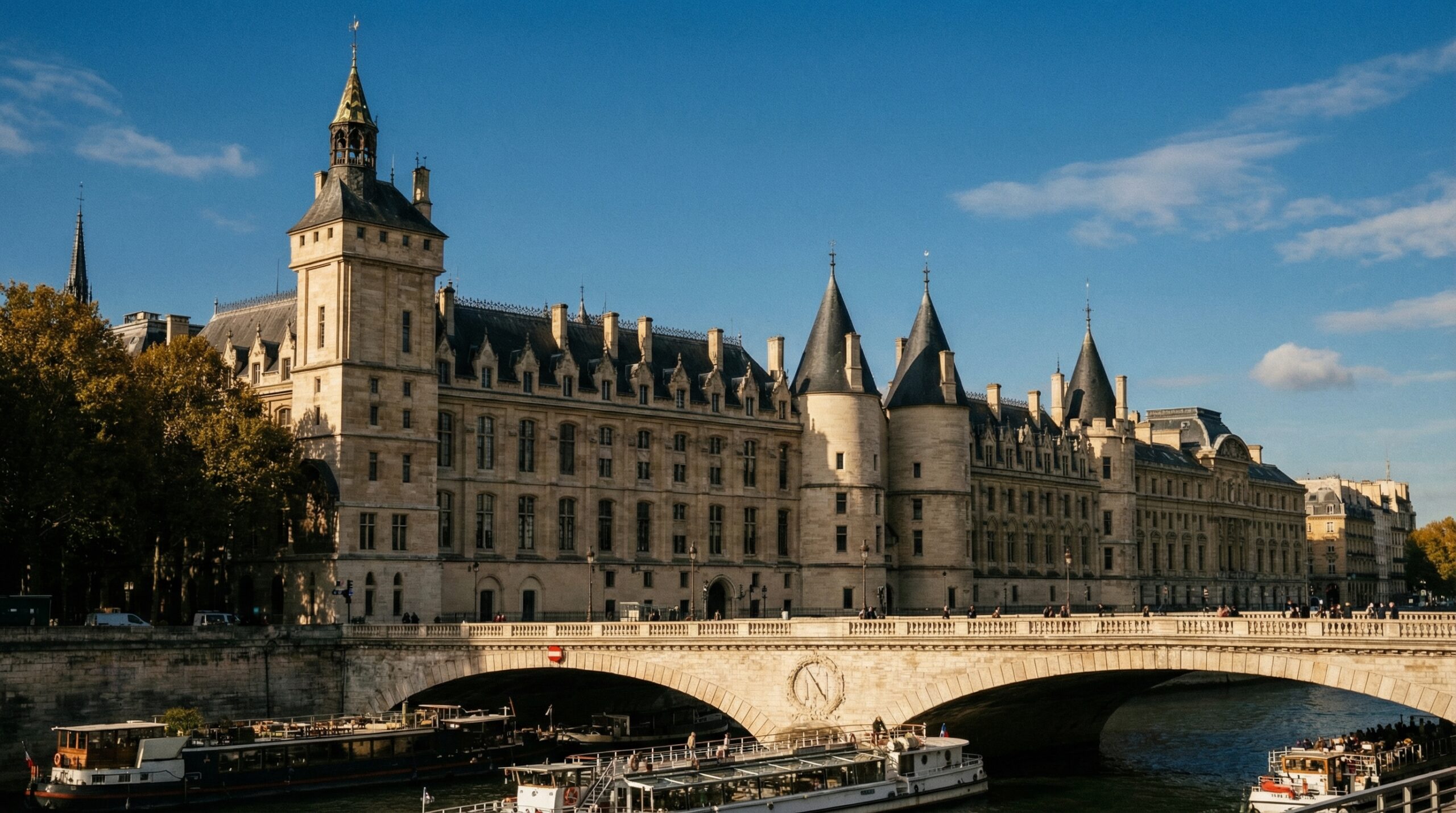
Few buildings in Europe carry as many layers of history as the Conciergerie in Paris. This UNESCO World Heritage Site stands on the Ile de la Cité in the middle of the River Seine. It served as a royal residence and a seat of government for centuries. Later it became a place of detention and finally a public monument. The history of this building reflects how France itself changed across the ages. The building did not just witness those changes. It stood at the center of them.
The Early Days of the Palais de la Cité
The story of the Conciergerie begins long before the modern building existed. People have inhabited the Ile de la Cité since antiquity. Records show that a royal or administrative residence existed on the site as early as the 4th century AD. King Hugh Capet established the Royal Council here in the 10th century. He was the first Capetian king of France. He also moved the administrative departments of the French kingdom to the Palais de la Cité. From that point on, the island became the political heart of France.
The Medieval Architecture of Philip the Fair
Successive kings expanded and improved the palace over the following centuries. Louis IX added the Sainte Chapelle to the complex in the mid 13th century. Philip IV undertook the most ambitious construction project of the medieval era. He commissioned the grand Gothic halls that still define the building today. The Salle des Gens d’Armes is the most famous of these halls. Builders finished it between 1302 and 1314. It remains the largest non religious Gothic hall in Europe. Up to 2,000 royal servants and soldiers ate their daily meals in this massive room. Four enormous fireplaces provided heat for the space. Philip IV also added the four towers that create the famous silhouette of the building today. These are the Bonbec, Silver, Caesar, and Clock Towers.
From Royal Residence to a Place of Law
The name Conciergerie comes from the title of Concierge. This high royal official maintained order within the palace. He also oversaw the police and registered prisoners. King Charles V decided to abandon the Palais de la Cité as a royal home in the 14th century. This followed the violent incursions led by Etienne Marcel in 1358. The Concierge then gained greater authority over the lower courts. Workers gradually added prison cells to the lower parts of the building. This shift began the long second life of the Conciergerie as a place of detention.
The Official Transformation into a Prison
By 1391, the Conciergerie officially functioned as a prison. In its early years, it housed a mix of common criminals and political detainees. This included Ravaillac, who assassinated King Henry IV. Guards held him there before his execution in 1610. The building served as both a courthouse and a prison for several centuries. It operated under the Parliament of Paris. This was the highest judicial court in the kingdom during the Old Regime.
The Salle des Gardes served as the antechamber to the Grand Chambre above. The Parliament of Paris convened in that upper room. The king also held his most solemn judicial hearings there. These were known as Beds of Justice. The royal residence eventually moved to the Louvre and then to Versailles. After that move, the Grand Chambre became the center of French judicial power. This connection between the building and the court system became decisive during the Revolution.
The Revolutionary Tribunal and the Reign of Terror
The French Revolution defines the history of the Conciergerie more than any other period. In March 1793, the government installed the Revolutionary Tribunal in the Grand Chambre. They renamed the space the Salle de la Liberté. The Tribunal had a mandate to try enemies of the Republic. The Conciergerie became the primary detention center for those awaiting trial in September 1793. This followed the adoption of the Law of Suspects. Officials transferred suspects from prisons across Paris. Most prisoners stayed for only a few days before appearing before the Tribunal.
Inside the Antechamber of the Guillotine
The building quickly earned a notorious nickname: the Antechamber of the Guillotine. This title involved some exaggeration. In reality, more than a third of defendants escaped the death penalty between 1793 and 1795. However, the rate of executions increased sharply during the Great Terror. This period lasted from April to July 1794. The reputation of the Conciergerie as a place of death became firmly established. Once the court sentenced prisoners, guards escorted them to the Salle de la Toilette. Officials confiscated their personal belongings there. Finally, carts in the May Courtyard transported the prisoners to guillotines across Paris.
Many notable prisoners stayed at the Conciergerie during this time. These included the poet André Chénier and the 21 Girondin deputies. The Girondins were moderate republican politicians. Historical accounts say they shared a final meal in the Girondins Chapel before their execution in October 1793. The Hall of Names records the names of over 4,000 people today. The Tribunal judged all of these people. Most of them came from the middle and lower classes rather than the nobility.
The Imprisonment of Marie Antoinette
Marie Antoinette remains the most famous prisoner in the history of the Conciergerie. She was the last queen of France. Officials transferred her from the Temple prison to the Conciergerie on August 2, 1793. This occurred after the execution of her husband, King Louis XVI. She spent approximately 10 weeks in a private cell. Guards watched her continuously during her stay.
Her trial took place on October 14, 1793. The proceedings lasted through the night. The court found her guilty and executed her two days later. The execution took place at noon on October 16 in what is now the Place de la Concorde. She was 37 years old. Officials buried her in a mass grave after her death. Twenty years later, the restored monarchy moved her remains to the Basilica of Saint Denis. She now rests there alongside her husband.
A Monument to Public Memory
The Conciergerie continued to function as a prison well into the 19th century. It held figures like Marshal Ney and Georges Cadoudal. The state formally classified it as a historical monument in 1862. However, it remained an active prison until 1934. The building opened to the public in 1914. Significant restoration work took place throughout the 19th century. Architects added the neo Gothic facade between 1820 and 1828.
The Clock Tower on the exterior holds its own place in history. The clock installed there in 1370 was the first public clock in Paris. It provided the first timepiece visible to ordinary citizens. It remains on the facade today as a reminder of the building’s long life. Today, the Conciergerie draws visitors from around the world. Its preservation represents a deliberate act of public memory. We keep these spaces intact so that no one forgets the royal splendor or the revolutionary violence.
Discover Paris with Uncle Sam Tours
An expert guide can bring these stories to life in a way that books cannot. You can see the Conciergerie as part of a larger adventure through the city. Uncle Sam Tours offers a specialized day tour that visits the most important sites in Paris. This full day experience allows you to see how the Conciergerie fits into the wider story of France