

The Palace of Versailles is not simply a building. Instead, it serves as a physical record of a monarchy that once held absolute power over France. It is the very place where that power eventually collapsed. Consequently, few sites in the world carry that kind of weight within a single set of walls.
Every year, more than eight million people travel to Versailles, France. They walk through its gilded halls, stand before its mirrored galleries, and wander across gardens that stretch beyond the horizon. However, many visitors arrive with only a vague sense of what they are looking at. This guide changes that. Whether you are planning a Palace of Versailles day trip or are still deciding if the journey is worth it, the following details provide the full picture.
Who Built the Palace of Versailles and Why
The story of the Palace of Versailles begins with a modest hunting lodge rather than grandeur. Specifically, Louis XIII built a small retreat in the village of Versailles in 1623. It was a functional place to sleep after hunting in the surrounding forests. Later, his son, King Louis XIV, imagined something entirely different.
When Louis XIV assumed control of the French government in 1661, he moved the royal court out of Paris. His reasons were both practical and calculated. To begin with, Paris had seen political unrest known as The Fronde during his childhood. Therefore, the king understood that keeping the nobility close would consolidate his authority.
From Hunting Lodge to Seat of Power
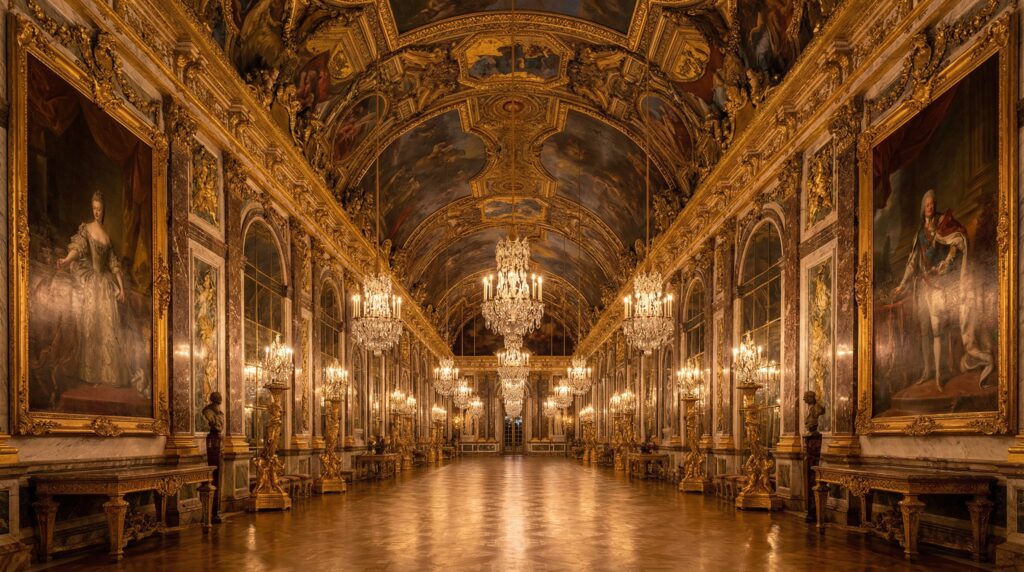
Construction at Versailles began in earnest, and the lodge transformed into a palace over several decades. By 1682, Versailles officially became the seat of the French government. Famous architects shaped this vision. For instance, Louis Le Vau expanded the original structure, while Jules Hardouin-Mansart completed the celebrated Hall of Mirrors. Additionally, Charles Le Brun oversaw the interior decoration to create a visual language of royal power. André Le Nôtre designed the gardens, creating the definitive example of the French formal style.
By its peak, the palace contained roughly 2,300 rooms. This figure includes private apartments, state rooms, and chapels. While the exact room count shifted during various renovations, 2,300 remains the most widely cited figure today.
Quick Facts
- Construction began: 1661 under Louis XIV
- Became royal seat: 1682
- Approximate number of rooms: 2,300
- Location: Place d’Armes, 78000 Versailles, France
- Distance from Paris: approximately 20 km southwest
Architecture, Art, and the Interior
The Palace of Versailles architecture follows the Baroque style, yet it maintains a distinctly French interpretation. While Italian Baroque favors drama, the French version emphasizes symmetry and control. Every design choice communicates one idea: power has a center, and that center is the king.
The main facade stretches for about 680 meters. The central section, which housed the royal apartments, features the most decoration. Gilded ironwork and stone sculptures give the exterior a dense level of ornament. Furthermore, the Palace of Versailles interior intensifies this quality. Rooms feature painted ceilings, marble floors, and furniture designed specifically for each space.
The Symbolic Center: The King’s Bedroom
The King’s Bedroom sits at the symbolic center of the palace. This placement reinforced the monarch as the focal point of the state. Each morning, the king performed the formal Levée. This highly ritualized ceremony of waking and dressing took place before assembled courtiers to transform ordinary acts into political theater. In short, the king transformed ordinary acts into political theater.
Additionally, the Palace of Versailles painting collection is vast. Artists like Le Brun and Pierre Mignard covered the walls with works that reinforced the king’s narrative. Similarly, the Palace of Versailles statues number in the hundreds. Many draw inspiration from classical mythology to reflect the monarchy’s image.
Why the Palace of Versailles Is Important
The Palace of Versailles history extends far beyond the reign of Louis XIV. The palace served as the royal residence for Louis XV and Louis XVI as well. Eventually, the French Revolution directly confronted the monarchy here. In October 1789, a crowd marched from Paris and forced the royal family to leave permanently. As a result, Versailles as a seat of power came to an end.
This moment marks the final collapse of the Ancien Régime. By ending this long-standing system of absolute monarchy, the Revolution reshaped the political landscape of Europe forever. The palace stands as a physical document of that shift. Later, the palace regained global significance. For example, the German Empire was proclaimed in the Hall of Mirrors in 1871. Furthermore, leaders signed the Treaty of Versailles there in 1919 to end the First World War.
Planning Your Visit: Tickets and Timing
The palace is 20 kilometers southwest of Paris. Getting there is straightforward because the RER C train runs directly to the Versailles Château Rive Gauche station. The journey takes around 40 minutes.
Regarding Palace of Versailles opening hours, the palace usually opens Tuesday through Sunday from 9:00 AM to 5:30 PM. Note that it is closed on Mondays. Since gardens and Trianon hours differ, you should check the official website before arriving.
Best Times to Visit
I strongly recommend buying Palace of Versailles skip-the-line tickets online, especially during peak season. To avoid crowds, visit on a Tuesday or Wednesday and arrive at 9:00 AM. Weekends and holidays draw the largest crowds. Consequently, the Hall of Mirrors becomes packed by mid-morning. If you want a quieter experience, consider visiting in November or March.
A focused tour of the main palace takes roughly two to three hours. If you add the gardens, plan for a full day. To explore everything comfortably, you will need six to seven hours. Both Palace of Versailles guided tour and private tour options are available through Uncle Sam Tours. These tours add vital context to the political meaning behind the layout.
Ready to See the Palace of Versailles?
Uncle Sam Tours offers guided and private tours of the Palace of Versailles with skip-the-line access, expert local guides, and itineraries designed to cover what actually matters. Skip the guesswork and arrive knowing exactly what you are looking at.