
The three main areas of Versailles you cannot miss are the Palace interior, the formal Gardens and Fountains and the Trianon Estate with Marie Antoinette’s Hamlet. Each area offers a completely different experience and skipping even one of them means leaving with only a partial picture of this extraordinary place. Most visitors spend all their time inside the Palace and then wonder why the trip felt rushed or incomplete. This guide walks you through each of the main areas of Versailles, what makes each one worth your time and how to pace yourself so you actually enjoy the day.
The Palace Interior and the Main Areas of Versailles
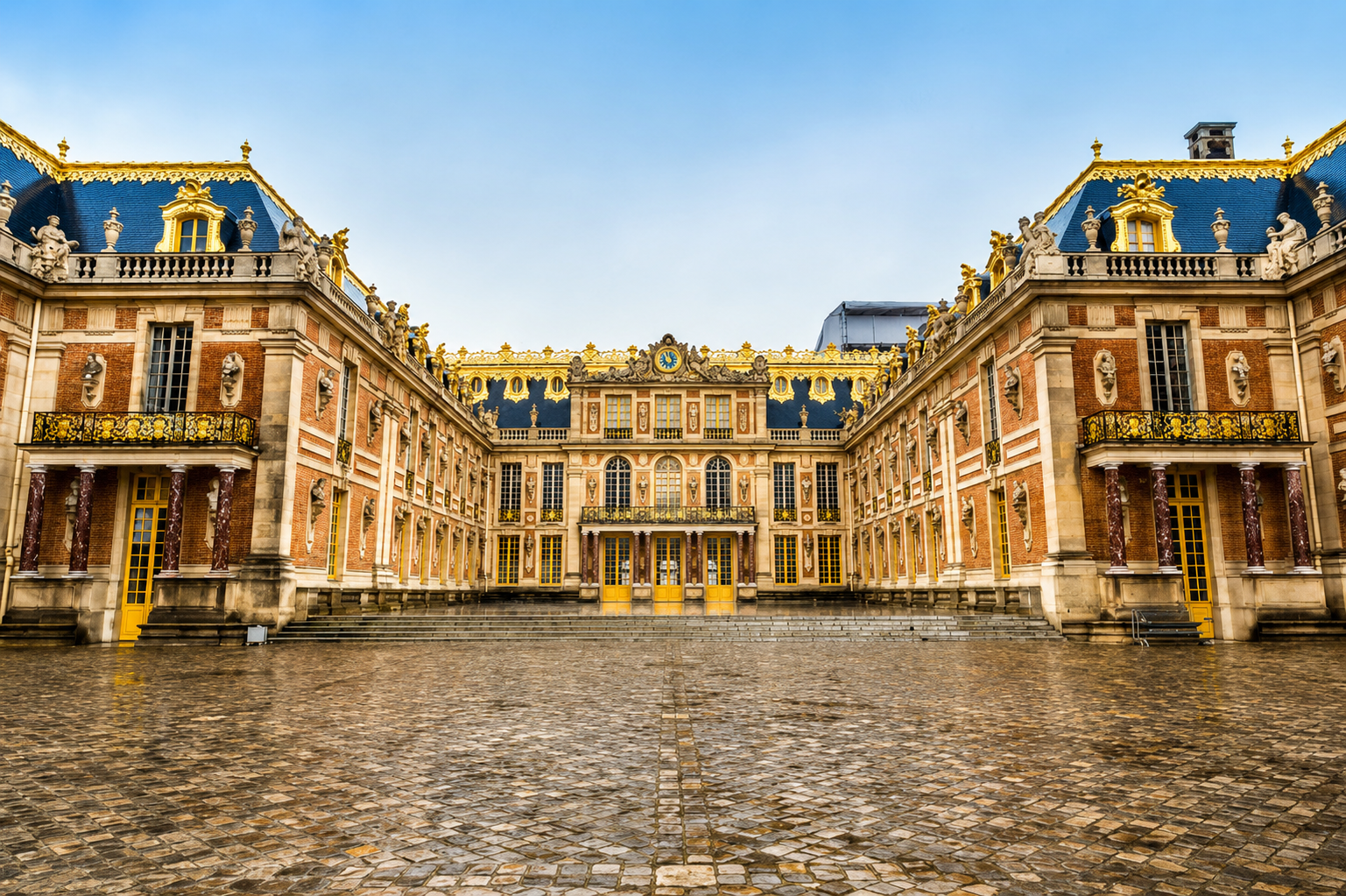
The Palace opens at 9 am every day except Monday. Arriving right at opening is the most important thing you can do to enjoy it. By mid-morning, tour buses have already flooded in and the rooms fill up fast. The main entrance is through the Cour d’Honneur, the grand courtyard you step into after passing through the iconic golden gates. Those gates are not the originals. They were destroyed during the French Revolution and replaced in 2008 using steel coated with 100,000 gold leaves.
The Palace has over 2,300 rooms, so the goal is not to see everything. Plan for about 1.5 to 2 hours inside the main Palace if you are focused. That covers the King’s State Apartments, a series of rooms each named after a planet or Roman deity and then the crown of the whole visit, the Hall of Mirrors.
What Makes the Hall of Mirrors Worth Your Time
The Hall of Mirrors is 73 meters long, lined with 357 mirrors arranged in 17 arched bays. Each bay faces a window that looks out over the gardens. It was built between 1678 and 1684, designed by architect Jules Hardouin-Mansart and decorated by painter Charles Le Brun. Le Brun painted 30 ceiling compositions documenting the first 18 years of Louis XIV’s reign. The sheer scale of the room is something photographs cannot prepare you for. It is larger, taller and more intricate than almost anyone expects.
In 1871, the German Empire was proclaimed here after France’s defeat in the Franco-Prussian War, a moment the French found deeply humiliating. Then, in a pointed act of historical reversal, French Prime Minister Georges Clemenceau chose this exact room to sign the Treaty of Versailles on June 28, 1919, formally ending World War I. Standing in that gallery with all of that history above you is a feeling that does not come through a screen.
The Story Behind the Mirrors
Louis XIV insisted that everything in the Palace be made in France. Venice held a monopoly on mirror manufacturing at the time. The French government persuaded Venetian glassmakers to defect and share their craft. The Venetian government reportedly ordered the assassinations of those defectors to protect the trade secret. The Hall of Mirrors stands, among other things, as proof of how seriously France took its own self-sufficiency.
To get the most from your time inside, arrive right at opening or visit after 3 pm when crowds begin to thin. Book your timed entry ticket online well in advance, especially between April and October. Skip-the-line tickets can save up to three hours of waiting during peak season.
The Gardens and Fountains
A lot of visitors treat the gardens as an afterthought, something to glance at through the Palace windows before leaving. That is a mistake. The gardens at Versailles cover 800 hectares and were designed by André Le Nôtre, who began work on them in the 1660s under the direction of Louis XIV. The King identified himself with Apollo, god of the sun and the arts and that symbolism runs through every fountain, statue and tree-lined path across the grounds.
Plan to spend at least 1.5 to 2 hours here, more if the Musical Fountains Show is running.
When the Fountains Are Worth Seeing
The Fountains Show, known as the Grandes Eaux Musicales, runs from April to October, mostly on weekends and some Tuesdays and Fridays. During the afternoon session from around 2:30 pm to 5 pm, up to 32 of the historic 17th-century fountains run simultaneously to baroque music. The morning session from 10 am to noon runs only six of the major fountains. If you visit on a fountain show day, see the Palace in the morning and come to the gardens in the afternoon.
The Neptune Fountain at the northern end of the gardens has 99 water jets and serves as the grand finale of the afternoon show, running from around 5:20 pm. The Enceladus Fountain represents a giant buried under rocks with a water jet shooting from his mouth. Many of the smaller groves are only accessible on fountain show days, so some areas will be closed if you visit on a weekday in winter.
Visiting the Gardens in the Off Season
Between November and March, admission to the gardens is free and crowds are significantly thinner. The fountains do not run and some groves are closed, but the formal geometry of the landscape and the sense of scale are still remarkable. The gardens stay open every day, even when the Palace is closed on Mondays.
On fountain show days, there is an entrance fee for the formal garden area. The Passport ticket covers the gardens along with everything else, so it is the most practical option if you are already visiting the Palace. Wear comfortable shoes. The paths between key features add up quickly. There is a small electric train that runs from the Palace to the Trianon Estate if you would rather not walk the full 30 minutes.
The Trianon Estate
This is the area that too many visitors skip entirely and it may be the most human part of the whole estate. The Trianon Estate sits about 30 minutes’ walk from the main Palace, or 20 minutes by the electric train. It opens at noon every day except Monday, which works well if you have spent the morning inside the Palace.
The estate includes the Grand Trianon, the Petit Trianon and Marie Antoinette’s Hamlet. Together, they tell a quieter story about royalty than the grand ceremonial rooms of the main Palace.
The Grand Trianon and Petit Trianon
The Grand Trianon was built in 1687 by Louis XIV as a private retreat from the packed formality of the main court. It is a single-story palace in pink and white marble with a columned peristyle opening onto immaculate gardens. Napoleon later used it as a residence and the furnishings inside date largely from the First Empire period.
The Petit Trianon is a small neoclassical palace built for Louis XV and later given by Louis XVI to Marie Antoinette in 1774 as her personal retreat. She transformed the surrounding gardens from a botanical garden into an English-style landscape with grottoes, streams and follies. The result feels more like a private countryside estate than anything inside the main Palace.
Marie Antoinette’s Hamlet
This is the place that genuinely surprises most visitors. Marie Antoinette commissioned the construction of a rustic village on the estate grounds in 1783. It has thatched-roof cottages, a working farm, a mill and a tranquil lake. The official record from the Palace makes an important point on this. The Queen did not use the hamlet to play at farming. She came here for walks, relaxation and small private gatherings away from the rigid public theater of court life. The farm was real, managed by an actual farmer whose produce went to the Palace kitchens.
Walking through the hamlet, the contrast with the Hall of Mirrors is hard to ignore. One end of the main areas of Versailles is a 73-meter gallery built to project absolute power. The other end is a cluster of small cottages where the same queen came to breathe. Both are worth seeing.
Plan roughly 1.5 to 2 hours for the Trianon Estate to walk through the Grand Trianon, the Petit Trianon and its gardens and the Hamlet. If time is short, go to Marie Antoinette’s Hamlet first. Most visitors never make it there, which means it stays noticeably calmer than anywhere else on the estate.
How to Plan Your Full Day at Versailles
A full day is the right amount of time to cover all three main areas of Versailles without rushing. A quick 2 to 3-hour visit covers only the Palace highlights. A standard visit of 4 to 5 hours gives you the Palace and the main gardens. To include the Trianon Estate properly, plan for 6 to 8 hours.
The best time to visit is spring, from late March through early June. The gardens are in bloom, the weather is manageable and the summer crowds have not yet arrived. Weekdays are consistently better than weekends at any time of year. July and August bring the largest crowds and Tuesdays can also be busy because many Paris museums close that day.
If you visit on a Musical Fountains Show day, the Passport ticket covers the Palace, Gardens and Trianon Estate in one purchase and includes priority access. Book it online before you arrive. The Palace is closed on Mondays, December 25 and January 1.
Versailles rewards visitors who come with a plan. Walk through the Hall of Mirrors with the history of that room in mind, spend the afternoon in the gardens when the fountains are running and end the day at the Hamlet when the crowds have thinned. That sequence gives you the full arc of what this place actually is.
Plan Your Versailles Visit with Uncle Sam Tour
Covering all three main areas of Versailles in a single day takes planning and that is exactly where Uncle Sam Tours can help. Uncle Sam Tours specializes in guided day trips to Versailles from Paris, taking care of transportation and timed entry tickets .The guides know the estate well, so you can spend your time admiring the Hall of Mirrors instead of figuring out where to go next. If you want to see the Palace, the Gardens and the Trianon Estate without the confusion of navigating it alone, a guided tour is the practical way to do it. Check out Uncle Sam Tours to see their current Versailles availability and book your spot before you travel.