
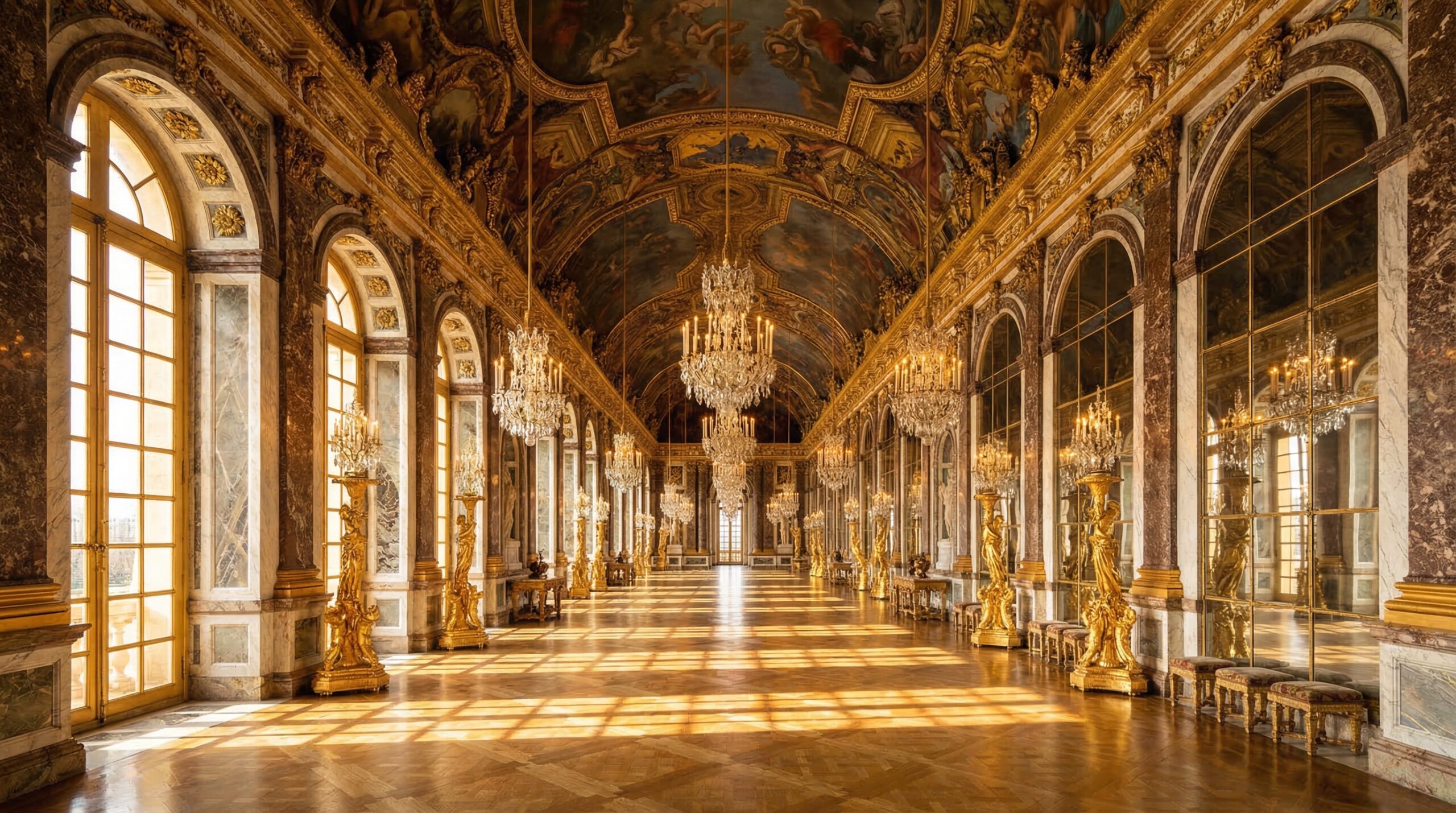
The Palace of Versailles stands as the ultimate center of the French world. Specifically, the Hall of Mirrors (Galerie des Glaces) remains the most famous room in the palace. Stretching exactly 73 meters (240 feet) long, it is flanked by the Hall of War and the Hall of Peace. Architects designed this space to broadcast the absolute power of King Louis XIV. At the time, mirrors represented the most expensive items a person could own. Consequently, the King’s demand for 357 mirrors served as a massive statement of wealth. He wanted to prove that France could produce luxury goods that surpassed the craftsmanship of Italy.
The Secret Scandal of the Mirror Makers
In the seventeenth century, Venice held a strict monopoly on mirror making, centered on the island of Murano. The Venetian government guarded these secrets so fiercely they threatened death and the imprisonment of families for any craftsman who shared them.
However, King Louis XIV’s Chief Minister, Jean-Baptiste Colbert, orchestrated a dangerous plot of industrial espionage. He successfully smuggled Venetian craftsmen into France to establish the Manufacture Royale des Glaces. Legend and some historical records suggest the Venetian “Council of Ten” sent assassins to poison the defecting workers to protect their trade secrets. Despite this “Mirror War,” the craftsmen survived long enough to teach the French, resulting in the mirrors that define the palace today.
Modern Restorations at the Palace of Versailles
If you visit the Palace of Versailles now, you will see the stunning results of the massive restoration project completed between 2004 and 2007 (and ongoing maintenance). Restorers carefully cleaned the 1,000 square meters of ceiling paintings by Charles Le Brun, which depict the military victories and administrative successes of the first eighteen years of Louis XIV’s personal reign.
During the process, experts used scalpels to remove layers of grime and old varnish, revealing the original gold leaf and vibrant lapis lazuli blues. They also restored the Oeil de Boeuf (Bull’s Eye) antechamber, named for its distinctive oval window. This Baroque masterpiece was where courtiers gathered in high-tension silence, waiting for the King’s doors to open.
The King’s Public Life and Daily Rituals
The King’s bedroom sits at the exact geographical center of the palace’s main axis. Because his life functioned as a public performance, everything revolved around the sun’s path and the King’s schedule. Every morning, the Levee (the Rising) occurred. This was split into the Petit Lever (for close family and physicians) and the Grand Lever (for high-ranking nobles).
In fact, the right to hold the King’s sleeve or offer him his shirt was a highly sought-after legal privilege. While this seems strange today, it was the only way for elites to gain “the King’s ear.” At Versailles, proximity to the King’s physical body equaled political survival.
Solving the Problem of Cold Food
Despite the palace’s grandeur, the logistics were a nightmare. The Grand Commun, where the main kitchens were located, was over 200 meters from the King’s table. By the time servants carried the plates through the Drafty Courtyard and up the stairs, the meat was often cold.
Louis XV, who valued privacy more than his predecessor, eventually solved this by building “Les Petits Appartements.” These included private kitchens and “flying tables” (mechanized tables that rose through the floor) so he could enjoy warm meals and host intimate dinner parties without a swarm of servants watching his every move.
Art and Propaganda Beyond the Mirrors
The palace is a museum of French history. Jacques-Louis David’s The Coronation of Napoleon is a massive 6-meter by 10-meter canvas that dominates its room. Interestingly, the painting is a “lie” of sorts—Napoleon’s mother is depicted in the center, though she did not actually attend the ceremony.
Similarly, Elisabeth Vigée Le Brun’s portrait of Marie Antoinette and her Children was a calculated piece of political public relations. Painted in 1787, it was commissioned to transform her image from a “spendthrift foreigner” to the “Mother of France.” The empty cradle in the painting refers to her daughter Sophie, who died during the painting’s creation, adding a layer of maternal tragedy designed to win public sympathy.
Insider Tips for Art Lovers and Photographers
Most visitors skip the private apartments on the upper floors, which is a mistake. To see the Petits Appartements du Roi, you must book a specific guided tour. These rooms were not designed for show, but for living. You can see the original woodwork and the small, recessed beds that feel significantly more personal than the “State Apartments” downstairs.
Photography Tips:
- The First Runner: The palace opens at 9:00 AM. If you are at the front of the line, head straight through the Royal Court and up the Queen’s Staircase to reach the Hall of Mirrors before the tour groups.
- The Reflection Trick: To capture the 17 arches without the glare of the windows, stand at a 45-degree angle to the mirrors.
- The Golden Hour: The palace follows an East-West axis. In the late afternoon, the setting sun aligns with the Grand Canal, sending a beam of light directly into the Hall of Mirrors.