
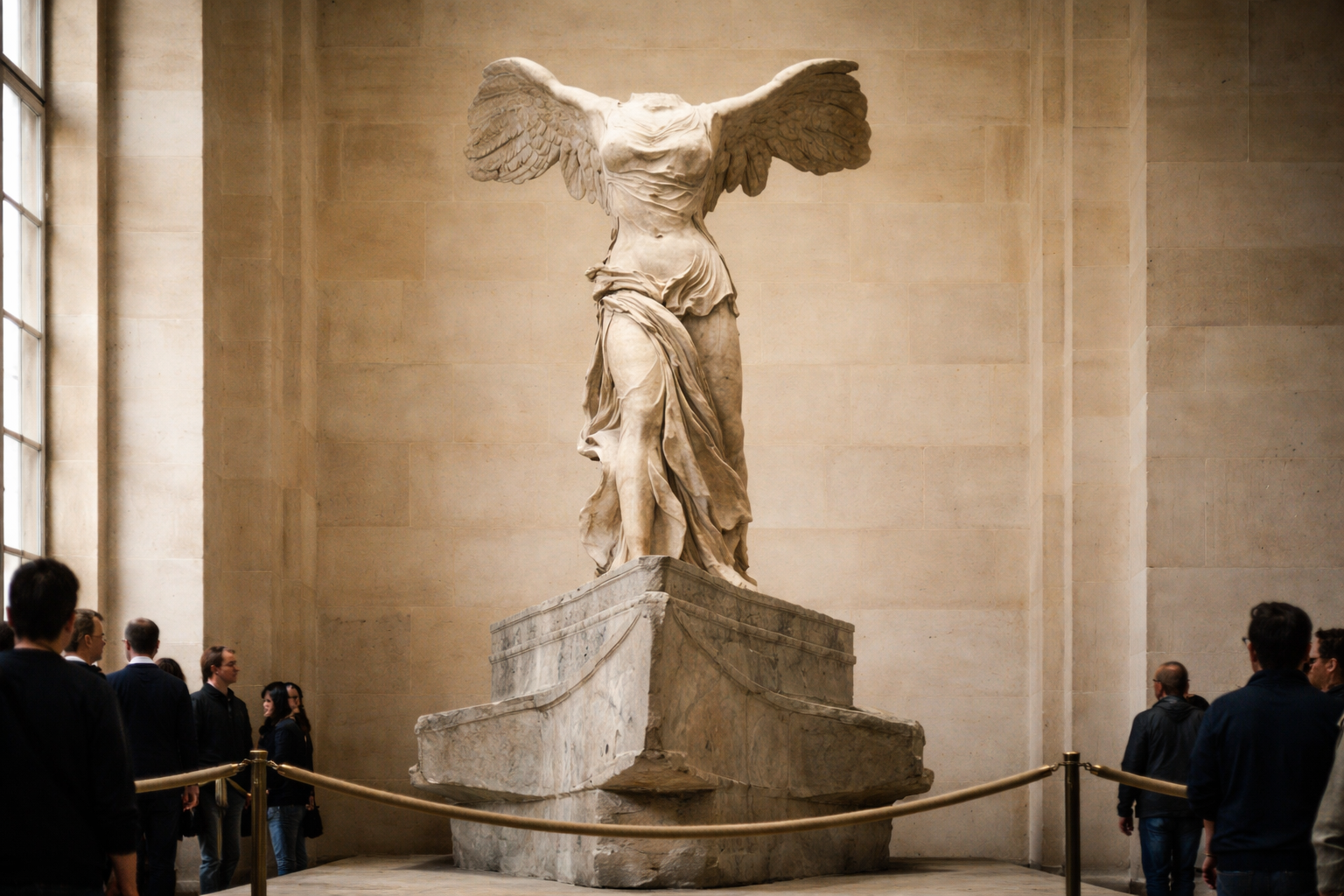
The Winged Victory of Samothrace stands as a monumental marble masterpiece from the early second century BC. Currently, this iconic sculpture commands the Daru staircase in the Louvre Museum. It represents Nike, who was the Greek goddess of victory. Because of its incredible detail and sense of motion, it remains one of the most celebrated examples of Hellenistic art in existence. The statue depicts a winged woman descending from the heavens to land on the prow of a warship. This pose captures a fleeting moment of divine triumph. To understand why this work continues to captivate millions, one must look deep into its origins, its dramatic discovery, and the technical genius of its unknown creators.
The Winged Victory of Samothrace: Sacred Origins and Naval Power
Ancient sculptors did not create this work for a museum gallery or a private collection. Instead, they designed it for the Sanctuary of the Great Gods on the rugged island of Samothrace. This northern Aegean location served as a premier religious hub in the ancient world. Sailors and naval commanders sought protection from the sea through secret rituals held at this site. Consequently, the placement of the statue on a high terrace above the theater created a dramatic sensory experience for ancient pilgrims. The island itself was known for its steep mountains and crashing waves, which provided a natural stage for a monument dedicated to a goddess of the sea and sky.
Historians believe the people of Rhodes commissioned the Winged Victory of Samothrace following a massive naval success. During the second century BC, Rhodes maintained a dominant fleet and served as a guardian of the Aegean. After defeating the Seleucid Empire in a pivotal battle, the Rhodians likely offered this statue as a gift to thank the gods. By placing the goddess on the prow of a ship, they created a permanent symbol of their maritime supremacy and divine favor. This was not merely art for the sake of beauty. It was a potent form of political propaganda that told the world that the gods themselves supported the Rhodian navy.
The sanctuary on Samothrace was unique because it remained neutral ground even during times of war. This meant that visitors from all over the Greek world could view the Winged Victory of Samothrace. The statue acted as a testament to the skill of Hellenistic artists who moved away from the stiff, formal poses of earlier eras. They wanted to capture the raw energy of nature and the intense emotions of human life. By choosing the goddess Nike, the artists linked the physical reality of war with the spiritual world of the Olympians.
The 1863 Discovery of the Winged Victory of Samothrace
The sculpture remained hidden under layers of debris and earth for centuries until 1863. Charles Champoiseau was a French diplomat and amateur archaeologist who arrived on Samothrace looking for ancient treasures. He was part of a generation of Europeans who were obsessed with uncovering the classical past. On April 15, his team unearthed a massive torso carved from white Parian marble. This was the finest stone available in the ancient world. Shortly after, they recovered fragments of the magnificent wings. Although the head and arms were missing, the sheer quality of the stone immediately signaled a major find.
Initially, Champoiseau focused only on the white marble pieces. He was a diplomat by trade and lacked the formal training of a modern archaeologist. He noticed large blocks of grey marble nearby but mistakenly thought they belonged to a tomb or a separate building. While he shipped the goddess to Paris in 1864, he left the grey base behind on the island. This decision meant the Winged Victory of Samothrace stood in the Louvre for over a decade without its essential naval foundation. Visitors saw a beautiful torso, but they lacked the context of the ship that gave the work its meaning.
The transport of the fragments was a massive logistical challenge. Workers had to move the heavy marble down steep hillsides to the shore. From there, they loaded the pieces onto a French ship bound for Paris. When the statue arrived at the Louvre, the museum staff recognized its importance immediately. However, they did not yet know how to display it properly. The statue sat in a temporary gallery while scholars debated its origin and its missing parts. This period of uncertainty lasted until more pieces of the puzzle emerged from the soil of Samothrace.
Unlocking the Mystery of the Ship Base
A group of Austrian archaeologists returned to the island in 1875 and corrected the oversight of Champoiseau. They conducted a more systematic excavation of the sanctuary site. They reconstructed the grey blocks that Champoiseau had discarded and realized they formed the front of a warship. Specifically, the dark Lartos marble from Rhodes contrasted with the white body of the goddess. This discovery proved that the Winged Victory of Samothrace was part of a unified composition where the goddess and ship worked together. The ship was not just a pedestal. It was a central part of the story the artist wanted to tell.
Champoiseau eventually returned to Samothrace in 1879 to reclaim these heavy blocks. He felt a sense of regret for leaving them behind and wanted to ensure the statue was complete. Once the ship base reached Paris, the museum finally understood the original vision of the sculptor. The contrast between the dark ship and the bright goddess made it appear as if she were landing through a sea spray. This arrangement elevated the work from a simple statue to a complex architectural monument. It showed that the Hellenistic Greeks understood how different materials could create a visual narrative.
The identification of the ship base also allowed historians to date the work more accurately. The style of the ship matches those used by the Rhodian navy in the early second century BC. This alignment of art and history confirmed that the Winged Victory of Samothrace was a victory monument. The base even includes details like the “oar boxes” and the “ram” of a warship. These features prove that the sculptor had a deep knowledge of naval architecture. They did not just carve a generic boat. They carved a specific type of warship that would have been recognizable to any sailor of that time.
Restoration Secrets from Plaster to Lasers
The restorers at the Louvre faced a massive challenge when they assembled the 118 original fragments. During the 1880s, the team used metal bars to support the 30-ton weight of the stone. This was a dangerous task because the marble was fragile after centuries in the ground. Since the right wing was missing, they created a plaster mirror image of the surviving left wing to achieve visual balance. Furthermore, the museum chose the top of the Daru staircase for its display. This choice ensures that visitors look up at the goddess just as ancient pilgrims did. The height of the staircase mimics the original terrace on Samothrace where the statue once stood.
In 2013, the museum launched a high-tech restoration to remove decades of Parisian pollution. Dust, smoke, and human contact had turned the white stone into a dull yellow color. Experts moved the statue into a temporary laboratory built right on the staircase. They used precision lasers to clean the marble without damaging the delicate surface. This method was far safer than using chemicals or abrasive tools. During this process, researchers found tiny traces of Egyptian Blue paint in the folds of the clothing. This discovery proves that the Winged Victory of Samothrace originally featured vibrant colors. This find challenges the myth that all Greek statues were plain white and sterile.
The 2013 restoration also uncovered evidence of how the statue was originally built. The sculptor used a series of bronze pins to hold the wings in place. This was a daring engineering feat because the wings are large and heavy. If the balance was off by even a few inches, the wings would have snapped off under their own weight. The restorers also discovered that the goddess and the ship were not carved from a single block. Instead, the artist used several blocks of marble and joined them with incredible precision. The seams were so tight that they would have been invisible to the naked eye when the statue was new.
The Artistic Genius and Engineering of Nike
The Winged Victory of Samothrace showcases the peak of Hellenistic engineering. Standing over 5.5 meters tall including the base, the statue required incredible balance to keep the heavy wings attached. The sculptor used “wet drapery” techniques to show the wind blowing through the clothes of the goddess. Every fold of the marble suggests the spray of the ocean and the force of the gale. The thin fabric of her tunic appears to cling to her skin, revealing the powerful form of her body underneath. This level of realism was unheard of in earlier periods of Greek art.
Moreover, the anatomy of the figure reveals intense physical effort. The tight muscles in the legs and the forward thrust of the chest show a goddess fighting against the wind to maintain her balance. Even though the head is gone, the body communicates a powerful story of energy and victory. The wings are not just decorative. They are shown in a position of “braking” as she lands on the deck. This attention to physics makes the Winged Victory of Samothrace feel alive. It is a snapshot of a single second in time, frozen in stone for eternity.
The engineering of the base is equally impressive. The grey Lartos marble blocks are interlocked to provide a stable foundation for the much heavier Parian marble figure. The sculptor had to account for the center of gravity of the entire monument. By leaning the goddess forward, the artist created a sense of motion while also distributing the weight more effectively. This combination of artistic vision and structural engineering is why the statue has survived for over two thousand years. It is a masterpiece of both form and function.
The Search for Missing Pieces and Future Discoveries
Many enthusiasts still hope to find the missing head or arms of the goddess. Archaeological teams have returned to Samothrace many times over the last century. In 1950, a major discovery occurred when a team found the right hand of the goddess buried in the dirt. This piece was crucial because it showed the hand was open. This proved that the goddess was not holding an object like a trumpet or a wreath. Instead, she was making a simple gesture of triumph. The hand is currently kept in a display case near the statue so visitors can see how it would have looked.
There are still many mysteries surrounding the Winged Victory of Samothrace. We do not know the name of the sculptor who created it. Some scholars suggest it was the work of Pythokritos of Lindos, but there is no definitive proof. There are also questions about the missing left hand and the exact position of the head. Some believe the head was turned toward the side, looking out over the sea. Others think it was tilted back in a cry of victory. Without these pieces, we can only imagine the full expression of the goddess.
The missing parts of the statue have actually contributed to its fame. The absence of a face allows the viewer to focus entirely on the movement and the drapery. It gives the work a universal quality that transcends a specific time or place. You do not need to see her face to understand that she is victorious. The power is in her stance and her wings. However, modern technology like 3D scanning and digital reconstruction is helping researchers test different theories about the missing parts. One day, we might have a digital version that shows exactly how the Winged Victory of Samothrace looked on the day it was unveiled.
The Cultural Impact of the Winged Victory
Since its arrival in Paris, the Winged Victory of Samothrace has influenced countless artists, writers, and thinkers. It became a symbol of the “Hellenistic Spirit,” which values movement, emotion, and realism. In the early 20th century, the Italian Futurists famously compared the beauty of a racing car to the beauty of this statue. They believed the statue represented the ultimate expression of speed and power. Even today, the image of Nike is used in everything from sports logos to modern cinema. The goddess of victory has become a global icon that everyone recognizes.
The statue also plays a role in the ongoing debate about cultural heritage. Greece has expressed interest in the return of the statue to its original home. However, the Louvre maintains that the statue is too fragile to move. The extensive restorations involving plaster and metal bars make any transport extremely risky. Furthermore, the museum argues that the Daru staircase is the perfect architectural setting for the work. Millions of people from every corner of the globe visit the Louvre specifically to see the Winged Victory of Samothrace. In this way, the statue serves as an ambassador for ancient Greek culture.
The architectural setting in the Louvre is a masterpiece in itself. The Daru staircase was designed to be wide and monumental. As you ascend, the statue slowly comes into view, towering over the visitors. This mimics the experience of an ancient traveler walking up the slopes of the sanctuary on Samothrace. The natural light from the ceiling reflects off the marble, highlighting the complex folds of the clothing. This presentation ensures that the Winged Victory of Samothrace remains the focal point of the museum. It is a rare example of a museum display that truly respects the original intent of the artist.
The Historical Context of the Second Century BC
To truly appreciate the Winged Victory of Samothrace, one must understand the era in which it was born. The second century BC was a time of immense change in the Mediterranean. The empire of Alexander the Great had fractured into several competing kingdoms. These Hellenistic states were constantly at war with each other. This environment of constant conflict created a high demand for victory monuments. Success in battle was the only way for a king or a city-state to maintain its power.
Rhodes was a unique player in this world. It was a wealthy republic that relied on trade. Unlike the great land empires, Rhodes focused on the sea. They built the most advanced ships and trained the best sailors. The Winged Victory of Samothrace was their way of saying that even though they were a small island, they were a superpower on the water. The art of this period reflected this ambition. It was bold, theatrical, and meant to impress. The statue captures the high stakes of the era, where a single naval battle could change the course of history.
This period also saw a shift in religious practice. People were moving away from the traditional gods of the city and toward more mysterious, personal deities. The Great Gods of Samothrace were part of this trend. They offered protection and a sense of belonging to those who were initiated into their cult. The Winged Victory of Samothrace bridged these two worlds. It was a traditional image of Nike, but it was dedicated to the mysterious gods of the island. This combination of the familiar and the secret is part of what makes the statue so intriguing to historians today.
Final Reflections on a Timeless Masterpiece
The Winged Victory of Samothrace is more than just a piece of carved stone. It is a record of human achievement, naval power, and religious devotion. From its birth on a rugged island to its modern home in a palace in Paris, the statue has survived earthquakes, wars, and the passage of time. Its discovery by Charles Champoiseau sparked a new era of archaeological wonder. The subsequent identification of the ship base by Austrian scholars restored the original narrative of the work.
Today, the statue remains a bridge between the ancient Aegean world and modern art lovers. It proves that true genius is timeless. The “wet drapery” technique and the expert engineering of the wings continue to inspire awe. The recent discovery of Egyptian Blue paint reminds us that our understanding of the past is always evolving. Even without a head or arms, the goddess Nike speaks to us across the centuries. She tells a story of triumph, beauty, and the enduring power of the human spirit. The Winged Victory of Samothrace will undoubtedly continue to command the halls of history for generations to come.
This famous sculpture is often mentioned alongside other legendary artworks featured in Exploring the Best Statues in the Louvre from Venus de Milo to Winged Victory, which highlights the most impressive sculptures inside the museum.