
When Notre Dame burned in 2019, the entire world watched in horror as the roof collapsed. This devastating fire was fueled by a massive wooden structure hidden beneath the lead tiles, famously known as “The Forest” (La Forêt). While its destruction was a global tragedy, the subsequent reconstruction has been nothing short of a miracle.
Why Was It Called “The Forest”?
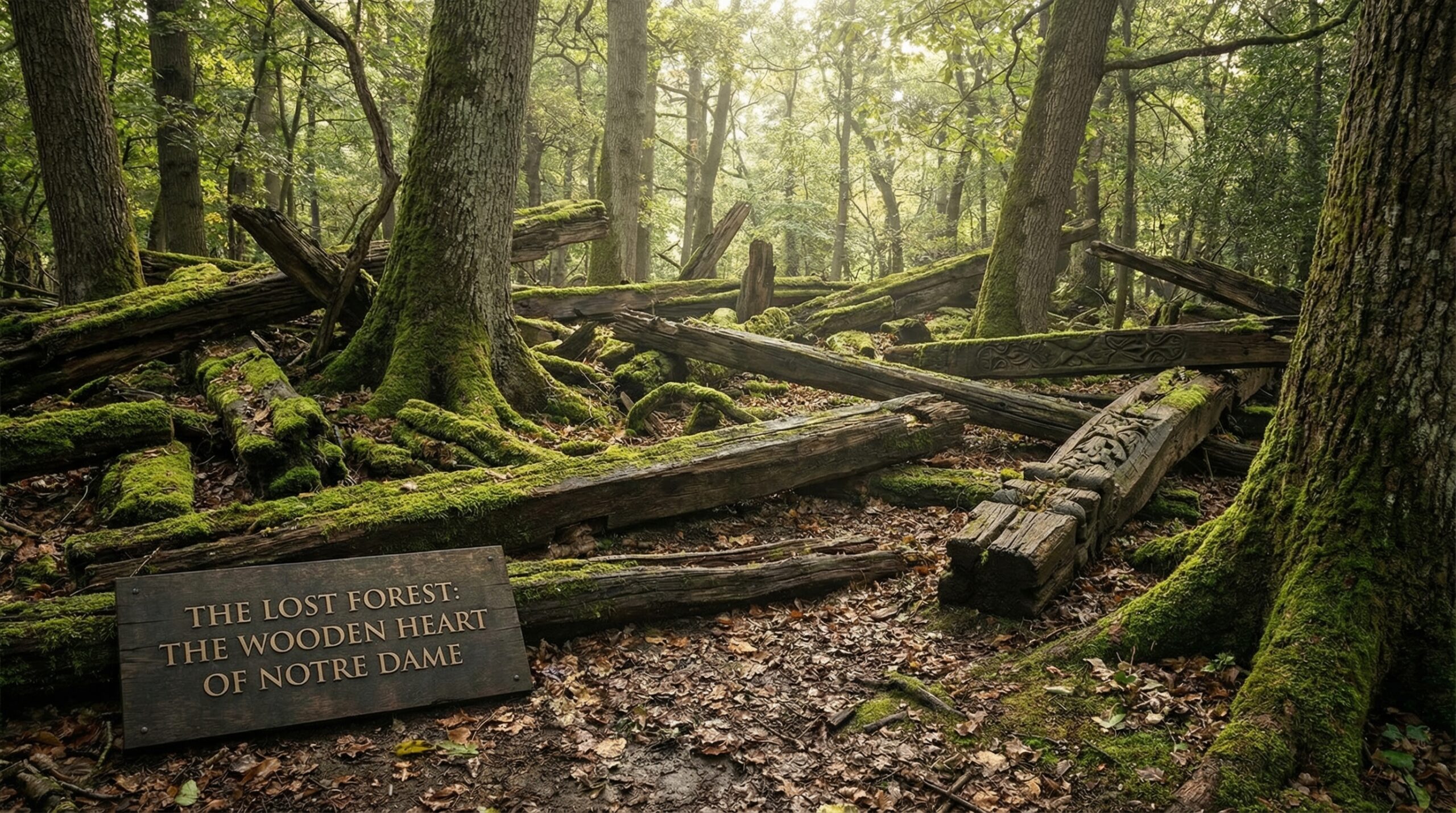
The nickname was quite literal because the framework contained so much timber that it effectively represented a small woodland.
- Quantity: The original structure utilized roughly 1,300 oak trees.
- Land Area: This wood was harvested from 21 hectares of forest land.
- Age: Remarkably, many of the beams dated back to the 12th and 13th centuries.
Because many of those trees started growing in the 800s and 900s, looking at the roof was like peering into a time capsule of medieval nature.
The Skeleton of the Cathedral
The primary purpose of “The Forest” was to support the heavy lead roof. Since the stone walls could not support the lead directly, the wooden frame acted as a vital internal skeleton.
Instead of using modern nails, medieval carpenters employed mortise and tenon joints. By carving a hole in one beam and a peg in the other, they fitted the wood together like a complex puzzle. Consequently, this design allowed the wood to expand and contract with the seasons without cracking the structure.
The Tragedy of the 2019 Fire
On April 15, 2019, a spark ignited this dry, ancient wood and turned the attic into a furnace. Within minutes, the fire spread across the entire length of the nave.
Because the roof was so high and the timber was so dry, firefighters found it impossible to stop the blaze. Ultimately, they had to allow “The Forest” to burn to save the stone towers. By the next morning, 800 years of history had unfortunately turned to ash.
The Decision to Rebuild Authentically
Following the disaster, France debated whether to replace the roof with modern steel or concrete. However, President Macron eventually decided to rebuild the structure exactly as it was originally designed.
This choice presented a massive challenge because modern sawmills do not produce beams of that scale. As a result, the project required a full return to medieval craftsmanship.
The Great Harvest and Hand-Hewing
To find the necessary materials, foresters scoured France for the perfect oaks. After locating tall, straight trees in both public and private lands, many landowners donated them for free.
Rather than using industrial saws, the restoration team utilized traditional axes. They hired skilled artisan carpenters to strip the bark and shape the square beams by hand. Because this technique follows the natural grain of the wood, the hand-hewn beams are actually stronger and more durable than saw-cut timber.
Why “The Forest” Matters Today
By 2024, the new roof was successfully installed. Although it remains hidden under the lead tiles and out of public view, knowing it exists changes how you perceive the cathedral. While the stone walls are the shell, the wood serves as the muscle. This reconstruction proves that modern society has not lost the skills of its ancestors; we can still build for the ages.