
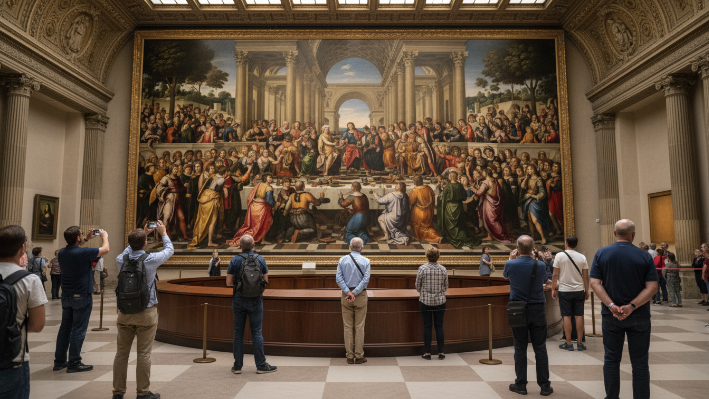
When you walk into Room 711 in the Denon Wing, you will likely see a massive crowd. Almost everyone pushes toward a small frame on the wall to look at the Mona Lisa. Unfortunately, they are also turning their backs on the largest painting in the Louvre. Directly behind that crowd hangs The Wedding at Cana by Paolo Veronese. This work covers the entire rear wall and is loud, colorful, and massive. However, most visitors barely glance at it. This guide explains exactly why you must turn around and look up at this masterpiece.
The Sheer Scale of The Wedding at Cana
The dimensions of this painting are hard to comprehend until you stand directly before it. It reaches a height of 6.77 meters and a width of 9.94 meters. Veronese did not paint this for a museum setting. Instead, he painted it for the dining hall of the San Giorgio Maggiore monastery in Venice.
He wanted the monks to feel like they were actually dining with Jesus. Because the figures are life-size, you feel like a guest at the feast when you stand at the base of the frame. Consequently, the work transforms the entire room into a historical scene.
Key Facts About The Wedding at Cana
The painting remains a technical marvel for several reasons. While Veronese used oil on canvas, the sheer number of subjects sets it apart from other works of the period. There are 130 unique figures in the scene along with seven dogs, one cat, and a parakeet.
The level of detail is truly obsessive. Every figure has a distinct expression and many are captured in mid-conversation or playing music. While the scene depicts the miracle from the Bible, Veronese chose to set the scene in sixteenth-century Venice rather than ancient Galilee. As a result, the architecture is classical and the clothing consists of luxurious Venetian silk and velvet.
Identifying the Guests at the Feast
Veronese filled The Wedding at Cana with famous faces from his own time. He treated the biblical event like a modern celebrity party. For instance, look at the group of musicians playing instruments in the center foreground. These are actually portraits of the greatest painters in Venice.
- Veronese: The figure in white playing the viola da gamba is the artist himself.
- Titian: The man in red playing the double bass represents the most famous painter of that era.
- Tintoretto: The figure playing the violin is widely believed to be Tintoretto.
Beyond the artists, you can also spot major political figures. Mary I of England and Francis I of France are both guests at this marriage feast. Veronese essentially ignored time and geography to place rivals at the same table.
The Logistics of the Largest Painting in the Louvre
The painting weighs hundreds of kilograms, so moving it is always a logistical nightmare. When the troops of Napoleon stole it in 1797, they could not transport it in one piece. Consequently, they cut the canvas in half. You can still see the faint line of that cut today if you inspect the surface closely.
During World War II, the Louvre evacuated the painting to protect it from potential bombing. They rolled it onto a massive truck and traveled through the French countryside to hide it in various castles. It only returned to Paris once peace was finally restored.
Why It Hangs Opposite the Mona Lisa
Curators placed The Wedding at Cana in the Salle des États because it is the only room large enough to hold it. Furthermore, there is a powerful thematic contrast between the two works. While the Mona Lisa is small, intimate, and dark, this masterpiece is huge, public, and bright. The two paintings represent opposite ends of the Renaissance spectrum. One focuses on the inner soul while the other focuses on the outer spectacle.
Practical Advice for Your Visit
You should not fight the crowd for the Mona Lisa immediately. Instead, walk to the back of the room and stand near The Wedding at Cana. You will have plenty of space to breathe and the lighting in this area is excellent. You can see the individual brushstrokes on the dogs and the incredible texture of the wine jars. This allows you to appreciate the largest painting in the Louvre without an elbow in your side.
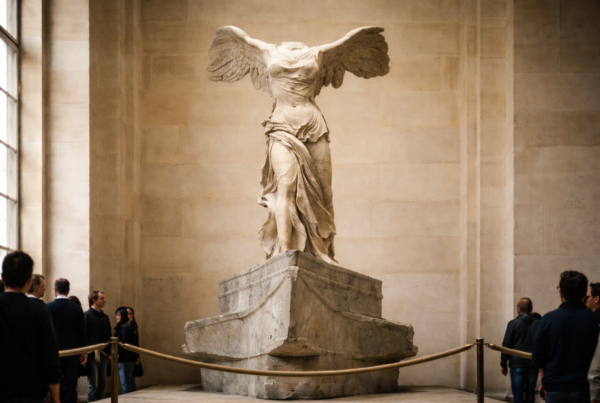
Beyond monumental paintings, the Louvre Museum is also famous for its sculptures, including the legendary statue explained in What Is the Winged Victory of Samothrace?